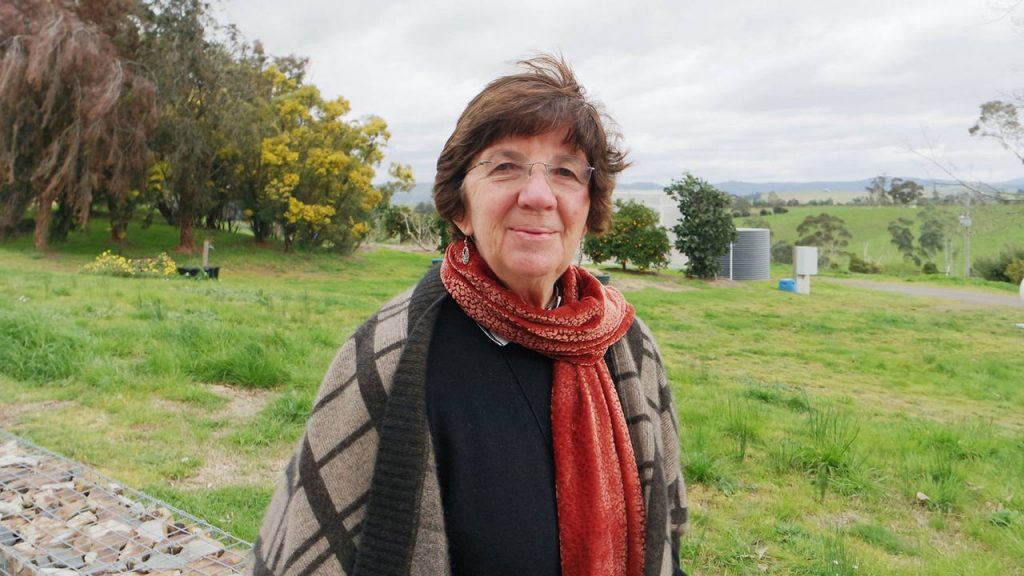

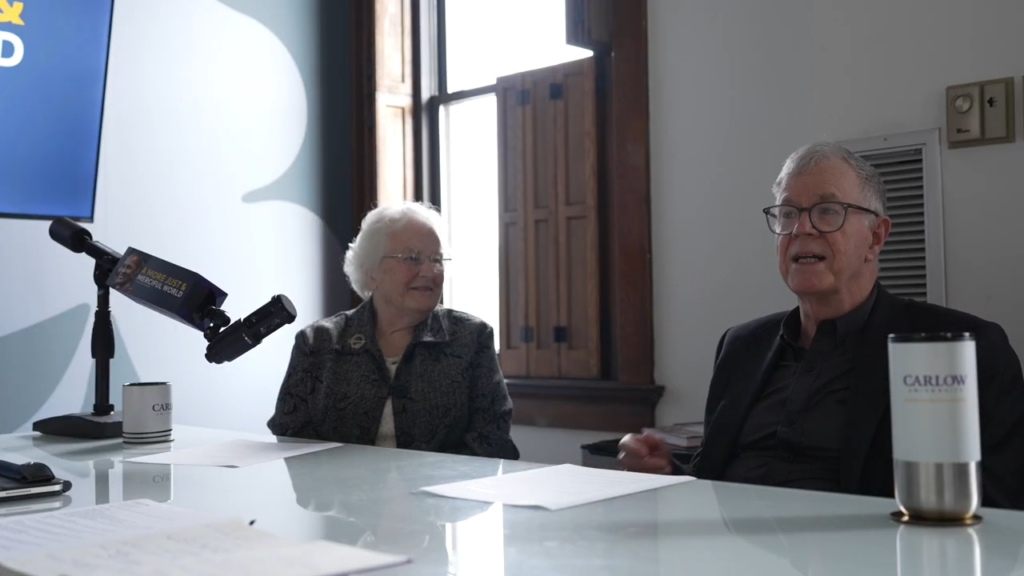
In 2024 Carlow University President Dr. Kathy Humphrey began hosting a podcast “A More Just and Merciful World.” Bringing together leaders, teachers, artists, and scientists from around the globe, Dr. Humphrey discusses mercy and justice in action with them. To date there have been twenty-seven episodes. They are available on the Carlow website (http://carlow.edu) or wherever you get your podcasts.
Kathy Humphrey (KH): Welcome to A More Just and Merciful World. I’m Kathy Humphrey, and I serve as the president at Carlow University. On this podcast, we talk to leaders, teachers, artists, scientists, and historians from around the globe to explore how to bring more justice and mercy into our world.
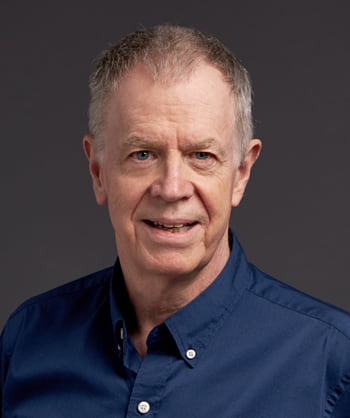
Today, we are so fortunate to have visiting our campus, Jim Keenan, a Jesuit priest who is known throughout the world in the area of ethics. Ethics is really important to us here, Jim, so we are grateful that you are on our campus, and that you’re going to share how we can become more ethical leaders. Because I do believe in days like we’ve had in the last few months, ethics is become core to, I think, our human existence.
So let me begin, and let me ask the question: Why ethics? Why did you decide to go in that area to become a well-known leader in this work?
James Keenan, SJ (JK): That’s a very funny question. The simple answer is that I had been a Jesuit for about 10 years, and I got a phone call one day. This would’ve been about 1980. I entered the Jesuits in 1970. 1980, I get a phone call. I answer the phone call, and this voice says, “Can I speak to Jim Keenan?” I said, “Speaking.” And he said, “This is Al.” I said, “Al who?” He said, “Your Vice Provincial for Formation.” I said, “Oh. Hi, Al.” And he said, “I’d like to see you today.” I said, “But you’re in New York.” He said, “No, I’m up here in Cambridge to see you.” And I said, “But the other six Jesuits from our province are all away.” He said, “I just came to see you.” Usually, when provincials arrive unannounced, it’s not good news. So I said, “Well, where are you?” He said, “Across the street.” I said, “Well, I’ll be right over.”
So the first thing he said to me is, “How are your vows?” I said, “My vows are fine.” He said, “Well, you’re going to be doing a doctorate.” I said, “I never did any thinking about doing a doctorate.” And he said, “Well, we decided yesterday at a provincial council that you’re going to do a doctorate, and we thought you should be the first to know.” And I said, “So much for Jesuit discernments.” And then I said, “And?” And he said, “And I’m here until tomorrow, because tomorrow you’re going to tell me what you’re doing it in.” So I said, “Really?” He said, “Yes.” I said, “I haven’t even thought about it.” He said, “You have 24 hours.” So I went home, and I lived in a Jesuit community of 12 guys, and they all said, “Oh, it’s about time somebody told you to do a doctorate.” And I said, “Well, okay, fine. What do I do it in?” And they all said, “You should do it in moral theology and ethics. You’re very interesting in class, and if you’re interesting in class, you must be interested in it. So what do you think of that?” And I said, “Oh, that’s a good answer.”
So I went back, and I said, “I’m doing it in moral theology.” So I made the decision in 24 hours.
KH: Oh, my goodness.
JK: That’s Jesuit discernment among Jesuits. Pack in very briefly. Normally, we accompany you, we walk with you, and we can go on for two, three years with you to help you to make a decision. We’re told to make one in 24 hours. So I did.
KH: So clearly, though, this was an interest.
JK: Yeah.
KH: This was an interest area, right?
JK: I didn’t know it until I was told that I had to come up with a topic, and I realized that the classes I was most interested in was social ethics, sexual ethics, global ethics. I was interested in all sorts of ethical issues, but I didn’t know.
I’ll add this. My father was head of Manhattan South Homicide Squad. And I was from Brooklyn. He was in Manhattan. So Kojak, he had the same exact role as Kojak. And my dad’s view-
KH: Okay, wait. Because there’s young people listening. They don’t know who Kojak is. So we better tell them.
JK: Yes. So Kojak was an internationally popular program. I can say, “Do you know the cop with the lollipop?” And everybody, anybody who is, let’s say, 50 years or older definitely will say Kojak right away. Whatever country they’re in. And it was about Telly Savalas, an actor who was playing this role of Kojak, and he was head of Manhattan South Homicide Squad.
KH: Mm.
JK: He would investigate murders and to see what was going on. But it was also about this world of justice that was seen by them, and that really influenced me a great deal. My father’s sense of justice, of who were really good people.
KH: Mm-hmm.
JK: I remember one day we were walking down the street, and there was a sex worker there. And I was only 12 years old, and he said, “They’re among the most honest people in this city. And the people who traffic them are among the worst people in the city.” At 12 years old, this is the lesson I’m getting from my dad, but it’s remained with me since.
KH: Yeah. That’s something. So Sister Sheila is with us today, and the audience knows Sister Sheila is a superstar here at-
Sister Sheila Carney (SC): Yeah
KH: … Carlow University, and we’re so grateful to have her, and Sister Sheila, let me turn to you for a second. Why bring Jim to campus?
SC: Well, there’s an interesting story there that has to do with the McDarby Institute. The institute is a program that we do every year for faculty and staff to investigate more deeply what it means to be a Mercy Catholic institution. And at the end of the series of topics that we talk about, we have a session on the works of Mercy.
KH: Mm-hmm.
SC: So we were using Jim’s book on the works of Mercy, and as we began the conversation, just to kind of get it started, I said to the group, “Well, what struck you in your reading?” And almost in unison, they said, “Mercy is the willingness to enter into the chaos of others.”
KH: Mm-hmm.
SC: And we had a wonderful conversation about that.
KH: Mm-hmm.
SC: The next year, the same thing happened. And the next year, the same thing happened. And then there was a tipping point where the whole university grasped that definition.
KH: Mm-hmm.
SC: And I think it struck us so powerfully because we recognize ourselves in it.
KH: Yeah. Mm.
SC: That when mercy is defined as entering into the chaos of others, we recognize that that’s what we do here every day. And that’s why we invited Jim to come and be with us today.
KH: And Jim, you cannot imagine how immersed that language is-
JK: Yeah
KH: … into our community.
JK: Sheila’s been telling me this lately.
KH: Yes. I’ve said it probably at least 100 times. Because I do think it rings true, and it’s easy to catch a hold of. It’s easy for us to help students understand what you’re agreeing to do with a college degree is the essence of you’re going to walk into the chaos of others.
JK: Right.
KH: When I talk to the nursing students at their pinning, it’s the ultimate act of walking into the chaos of others. When I talk to the teachers, right-it’s the ultimate act, the social workers. But also the business students as well. So, I’m thrilled that you are here because, since we’re using your language
JK: Yeah. Thank you.
KH: It’s nice to have the embodiment of that language-
JK: Thank you
KH: … right before us. So let’s move a little bit more into this notion of what you believe is, what is ethics? And what’s the core of it?
JK: Yeah. I would say that the core of ethics is really the familiarity that we’re related to one another. That we have some sort of need for one another. That we really can’t go it alone, and that there has to be an awareness within each of us of our dependence on one another. That’s what we don’t have in our world today. But it’s this dependence on one another, and that’s not a dependence in using people. It’s a respectful dependence.
But we don’t see that being encouraged. We don’t see that being raised up as a way of moving forward. Pope Francis, I think Pope Francis, Pope Leo, they’ve been real strong agents of it. One would like to see other church leaders follow their step. That would be helpful. Certainly, it would be nice to see political leaders doing that, too.
KH: That sure would. In some of your work, you talk about the consciousness formation.
JK: Mm.
KH: Talk to us a little bit about that.
JK: So one of the things is, I’ll say Thomas Aquinas has this line, “Can you ever go against your conscience and not sin?” Can you ever go against your conscience and not sin? And he said, “Never.” And I thought that that was really the best way to define conscience, is that conscience is something that commands you. It urges you to go in a certain direction. It’s not permitting you to do something, it’s actually engaging you. And if your conscience is telling you that this is the pathway-why would you take anything else? What else could you take? If you’re not following your conscience, what would you be following? You’d have to be following something that’s outside your conscience.
So Aquinas, when he makes this claim, he believes that conscience, regardless of what somebody may teach you, somebody may say, what a law may be, conscience commands us to go forward. We think of conscience as permitting us to do things. It doesn’t. It commands us.
So you (SC) were telling me about Sister Pat and your congregation and marching at Selma. I’m sure she did that because her conscience demanded her to do it. It wasn’t something that she was saying, “Oh, good. I’m going to get to go march in Selma.” It was really like, “I have to do this regardless of what’s going to happen.” So I think conscience is that urge in us that tells us to do something, that you really need to go in this way. And it’s a way that is, as most of us would say, it’s God’s voice in us. And it commands us in a very frequent way. We may not be attuned to it, but we try to. Us teachers try to help our students understand when is conscience functioning.
KH: But you also talk about this whole notion of vulnerability.
JK: Yeah.
KH: And what helps us to develop this vulnerability?
JK: Yeah, so I used to think that conscience was all about teaching students what they needed to know. So, the first time I started teaching was 1987. I taught at Fordham for four years. I taught a course called Abortion. People signed up. The course was closed in about five minutes. And I taught two or three sections of it, and I did an exam every class. They had three essays to read for each class. So say with 39 classes, we met three times a week. I ended up giving them about 120 essays to read. And my thesis was that everybody had an opinion on abortion, and nobody read anything on abortion. And so I wanted to teach.
And then later when HIV broke out, I was really interested in prevention of HIV, so I started teaching a course called HIV/AIDS and Ethics at Boston College, and that was really very, very popular. And I taught that for years, and that led to a public health program and everything else. But in all these, I was always teaching people what they needed to know, but I was not addressing the primary question of would they act. But now knowing all this, would they do anything in the first place? Would they be prompted to act? Would they follow their conscience? They had all this conscience material. Now, were they going to follow it?
And one day, at the end of a class on HIV/AIDS and Ethics I had 40 students in the class. They go lead, they work very hard. They were all professionals. They wanted to respond to a critical health issue in the world. And they left the class, and suddenly there was commotion in the hallway, and I could see that some other student from another class had fallen. Something had happened. I don’t know what it was, but something had happened. And I saw how my students were responding, and many were trying to respond, but others just shrugged their shoulders and walked away and said: “What was that?” And they showed no responsiveness at all to it. And I realized that I was teaching them what to do- but not that they had to do it. And so I began to say, well, what do they need to actually be open to another, to be willing to enter into the chaos of another?
And there’s a great feminist philosopher, Judith Butler, and she argues that it’s vulnerability. And she takes this from Emmanuel Levinas, that it’s really vulnerability. Vulnerability is not, we think of vulnerability as a vulnerable adult, as somebody who has a disability or has some difficulty and needs some help. But real vulnerability is an openness to the other. I’m willing to be wounded. Like Sister Pat again. She goes in the march, as do all the marches at Selma. They went there, they were vulnerable to something. But it was that vulnerability that got them there.
So prior to acting in conscience, what do you need? I say vulnerability. So I teach that all the time.
KH: So let me dive a little bit deeper in that, because I’m thinking about the scripture, and I can’t remember where it is right now, but I’m thinking about the scripture where, I think it’s Peter, maybe not, who says, “I want to do the right thing, but I don’t.”
JK: “Lord, help me in my belief.” “Lord, I believe, help me in my unbelief.”
KH: Help me in my unbelief. Yeah. Right. Because those words for me was like, I know what the right thing to do is. It’s just that I can’t make the leap.
JK: Right.
KH: So-
JK: That’s why I work on vulnerability. Most of us, as educators, teach people what they need to know, but not how to act. And I think more and more universities are doing that. But I think that ethicists don’t do that. Ethicists keep telling us what’s right and what’s wrong and how to think about this and how to be, but not what gets you to act in the first place. And so there’s a lot of work now going on by ethicists on this notion of vulnerability, and they also go on a notion of recognition, saying that if you are vulnerable, you will recognize the problem. But if you’re not vulnerable, you will not recognize the problem.
KH: Right. And so when you talk about that vulnerability, you also talk about the ability to respond.
JK: Yep.
KH: Right? But the leap from the vulnerability to the responsiveness, a lot has got to happen, right?
JK: Right.
KH: This is interesting. We’re talking about this. I was just sitting in church on Sunday, and we had an event that occurred where someone got sick. And people started scurrying, and it stopped the message, and everything started happening, right? But there were medical professionals there that didn’t get up. And I thought, I was disturbed-
JK: Yeah
KH: … actually, by it. And thought, “That person is a doctor. Why didn’t they move?”
JK: It was just like my experience watching my students in the hallway not responding. It’s like why not?
KH: And since then, because I’ve verbalized this several times in there, that there is this notion of liability. And so there’s a liability in the response. There’s always liability that enters into the response. But there’s another piece here that I think is interesting too, and that is it takes some courage to move from awareness to actually moving and doing something.
JK: Right.
KH: How do we help students? How do we help people? How do we help our community? I was in Germany last week, and people said: “Why aren’t you guys doing something?” And I thought, “That’s an interesting question.” Because from their standpoint, we’re not. So how do you get from here? Just, I know this is the right thing to do, to I’m doing the right thing.
JK: So two things. I’ll answer the second one, the last point first, and then I’ll go back to this other one. I think that right now in the United States, our biggest problem is we keep asking ourselves the same question. What should I do? What should I do? What should I do? And we’re doing it in our rooms by ourselves. And enough of that. We should be talking to one another. It’s not what will I do, or should do, but what should we do?
That’s again, the Selma model. That people got together. That’s how they did things together. And I do think that the critical question that many, many, many people who are not in marches and not doing anything but are really perplexed at what’s going on in the country, they’re not asking the basic question, what should we do? They keep asking, what should I do? And they go in their cubby hole of their existence, and they don’t come out and say, “You’re never going to find the answer by yourself.” Unless you have humility that you need to share that situation, unless you are vulnerable to your friends to say, “I really would like to do something. Do you have some ideas?” We don’t get to the big question of what should we do? And so that’s the first thing.
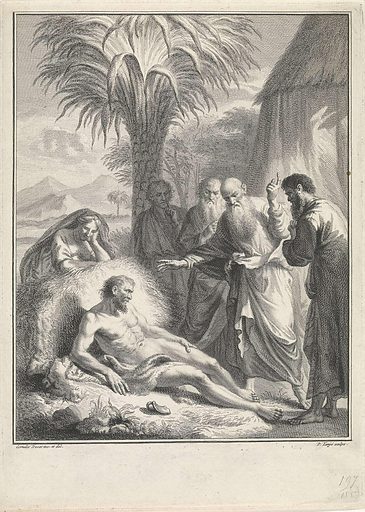
On the matter of vulnerability, one of the things that I love is the Good Samaritan parable, because after all, it’s the answer to who is my neighbor. And I think that this story is really about how the priest and the Levi who pass by the man who’s injured on the road, they’re the ones who are without vulnerability, and they don’t recognize the man on the road as being in need. It’s the good Samaritan who is able to recognize. So I would say that in order to teach about vulnerability, we need to teach people how to recognize, how to see what they do not see.
I think that a lot of programs that we have of teaching students by action, by going to different neighborhoods, by trying to understand other peoples, to really engage in their situation, to help them to recognize better what the situation of the world is, that helps ignite their vulnerability. And then we need to somehow get this vulnerability and recognition together.
So, the beginning of your question was basically, I think about vulnerability and how does it help us, and how do we create exercises for people to learn how to recognize?
But then I think there’s also this other way that once we begin to recognize what the issue is, we should realize that, though the Samaritan was going to do things alone, he ended up finding the innkeeper, and he ended up finding a lot of other resources and other people along the way. And I think that’s what we have to be able to do as well.
SC: If I could interject here, we’re about to have this experience on campus because we’re about to have Mercy Service Day when we send our first year class out around the city. And often students are very nervous about that because they think they’re going to be asked to do something that makes them uncomfortable or that they can’t do. So we have to help them to understand that they’re not going into these situations as experts. But they’re going to try to learn about the needs around our city, and to find a way to enter into that and to alleviate it.
KH: Which I think is a powerful lesson all by itself. But I’m truly intrigued by this notion that you can be ever so knowing. But not act.
JK: Right.
KH: Right? And how do we get our community ourselves to say, “I see it, and because that’s my vulnerability, I see it.” Right? I often say it’s difficult for you to know what my shoes are like because you don’t really see me. And until you see me, you really can’t help me, right? How do we get people, though, to the point where what you talked about initially, my consciousness is formed to the point where I must act?
JK: And I think though, that’s where we do ask one another for help. I think that we need to have a humility, not just about ourselves, but ourselves in need of our friends to help us.
I find that occasionally I take stands that will get me in trouble.
KH: No
JK: Yes. But before that, now I talk more to some of my friends ahead of time just to be able to plan out what are my alternatives as things unfold. And I think that that’s really rather important. I think that we do too much reflecting on what should we do by ourselves, and we don’t really say, “Can you help me? Can you give me some advice along the way?” The disciples, there were 12 of them. He didn’t choose one or two. He chose a pretty big crowd. And that there was a certain way that there was an expectation that they would communicate. He sends them out two by two. He very rarely leaves a disciple to himself.
I think that religious orders were based on that. That we always worked in collectives. And I think that more and more we have to be thinking about collectives.
In ethics today, the big discussion is that we used to always think all of agency came down to the person, and we kept emphasizing that. The person decides. Well, what do you mean, one person or many persons? And that’s what most of us are now bringing up with saying, “No, you do these things not alone. You do with others.” And you have to learn in America more about how you need to work with others.
In other cultures, they’re much more collective. Our culture is a standalone culture, and that’s one of the things that inhibit us from acting on our vulnerability and communicating our recognition collectively.
KH: You’ve spoken of this notion of the responsiveness is the answer to the call. And oftentimes, just in general, students or alumni, people are trying to figure out, “What’s my call?”
JK: I think they have to be talking to one another about that. Like you say, I can’t answer all of them, but often enough, I may not be able to answer everything, but I probably share with others that I can’t do this. Can you? Or I can’t do this, but you’d be much better at it.
I think that as we get older and more professional, we surround ourselves with friends who we’re able to share visions with and able to see what expectations are, and we actually communicate to one another saying, “How about if you did this rather than me?” But if we were more collective, I think we would be less hesitant and more capable of moving forward.
In America, we don’t have that many models for that. We don’t have political parties that do anything, but one is fragmented and the other one just takes a one-person point of view. So we have to see other models for our students and for ourselves of how we responsibly recognize one another’s talents to allow their agency to emerge rather than always ours.
KH: Thing that I heard, and I’m going to end with this, is I heard you say that all this equates to love.
JK: Yep.
KH: I don’t mind using the word love around here at all. As a matter of fact, I say to students as they’re coming in, “We’re going to love you here.” Because I do believe that love requires something different of us. And I think if we really love, we don’t leave the man on the road. We don’t leave our fellow brother struggling when we can help, even whether we know we can or not.
So I want to thank you because I believe your message will be powerful. I also want to thank you for coining that phrase that we use here, that we believe that Mercy is indeed walking into the chaos of others, meaning that we’re willing to respond, we’re willing to be vulnerable, and I am sure that we will all get much wisdom from your words today.
So thank you for being with me.
Thank you, Sister Sheila, for being with me as well.
JK: Thank you, Kathy
The use of this podcast recording was done with permission from Carlow University.