

A year or so ago, I was listening to an online presentation by artist and spiritual writer Jan Richardson. In reflecting on the many books she has written and talks given, she paused and said: we really have only one message. Everyone has a message that belongs to them that captures the essence of their conviction about what their life is all about. One message we carry and deliver over and over again with our very lives. This prompted significant self-reflection. When I was 25 years old, I found a book of poetry by a poet who was two years older than myself. I selected it from a shelf, stood in the bookstore reading, and then my eyes focused on this:
I was twelve when I killed him; I felt my own bones wrench from my body. Now I am twenty-seven and walk beside this river, looking for them. They have become a bridge that arches toward the other shore.1


Chicago Sun-Times, November 22, 1961
How else do I say it? I was eleven when I killed him. Accidental as the shooting may have been my younger brother died at my own hands. That was 1961. The Chicago Sun Times printed a tiny little article at the time of his death with the headline, “Gunshot Is Fatal to 8-year-old Boy.” “Wadding from the blank hit Jude in the back after his sister, Avis, 11, fired the .38 caliber pistol at him from less than a yard away.” The guns in my cousin’s bedroom had been unloaded, but without any intentionality, my teenage cousin reloaded the pistol with blank cartridges and left the room. “Hey,” Jude said, “pretend you shoot me.” He took a rifle and turned his back to me. He got down on one knee and aimed the rifle. I took aim at his back and pulled the trigger. The newspaper reported, “Jude and Avis were playing in the rear of the home where they found two guns, the pistol and a .22 rifle. They were play shooting when the gun fired.” In reflecting on causing accidental death as a moral injury, David Peters said that when someone accidently causes the death of another, a code is broken and you are left wondering if you are no longer a good person.2
It was not until my twenties that I discovered a partner in grief and guilt through Gregory Orr’s haunting poem. I was eleven when I accidentally took Jude’s life. I was silent (as was everyone else in my world) on this tragedy for the majority of my life. In considering Jan Richardson’s comment about carrying a single message, I realized that my message, one of lament, is captured in poetry and guides my every day. I have spent my life walking there gathering the bones together, like Ezekiel, praying that the bones will live (RSV, Ezekiel 37:1-14) when one struggles in the “narrative wreckage” of one’s life so aptly described by Hebrew scripture scholar Kathleen O’Conner in Lamentations and the Tears of the World (2002). I have shared a kinship with the Book of Lamentations and its desolate emotions, complaint, and unbearable pain. Lamentations is a disturbing biblical poem because it exposes experiences, memories, and feelings most often exiled to the shadows. The Book of Lamentations, ancient as it is and only 5 chapters, written by the prophet Jeremiah in 586 BCE, speaks into the heart of lament—the stories of our lives that carry a grief like no other and the promise of our becoming through the wound to live into healing, and to be and bear that message forth with our very lives.
Kathleen O’Connor describes the testimony of the Book of Lamentations as bitter, raw, and unhealed; its poems use wounded words to disclose human suffering, announcing a ragged struggle to articulate pain and arrive at hope.3 In short, Lamentations is narrative wreckage crying out for the shelter of some new story that transforms the bitter cold, silent “house of sorrow” into the warm hearth that holds the presence of the Holy One once again.4 Like the prophet Ezekiel, those in lament wonder how the dry bones can live. Lament is visceral. It looks like the people who gather at the Western Wall, once referred to as the Wailing Wall, that last surviving remnant of the retaining wall that once supported the Temple Mount, the platform on which the First and Second Temples stood in ancient Jerusalem. After the Babylonians destroyed the First Temple in 587–586 BCE and the Romans destroyed the Second Temple in 70 CE, only portions of the outer retaining walls remained, with the Western Wall becoming the most accessible section. A sacred site of enduring Jewish prayer, mourning, and longing, it is common to see people from all faiths stand before the Wall and insert small slips of paper that hold their raw petitions of lament, grief, and hope into the crevices. The custom stems from the long‑held belief that the Divine Presence (Shekhinah) rests upon the Western Wall, making it uniquely receptive to the Divine Ear. Similarly, the Irish have the visceral practice of keening, which shares some features with the devotional practice at the Western Wall because they share an underlying orientation toward collective grief and the power of dangerous memories;5 yet their ritual orientation is different. Keening operates as a performative lament, vocal and associated with death and mourning, whereas prayer at the Western Wall constitutes a devotional practice that intertwines personal petition with the symbolic, enduring Jewish longing for the Temple interwoven with the wailing of human hearts seeking the balm of Divine Presence. In her early 50s I remember my mother saying, “Before I die, I want to go to the Holy Land and get to that “Wailing Wall” and take care of my business with God.” This she did in living her laments.
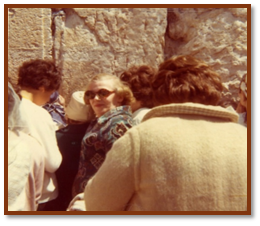
Margaret Ann Clendenen at the Western [Wailing] Wall in the early 1970s.
Those in lament come face to face with theodicy. Theology’s toughest question: how do we cope with an omnipotent, omniscient, and all-loving deity who allows evil and suffering to run unchecked in the world? How is it possible that endless pain and suffering exist along with a God who is good, loving, and all-powerful? Could not such a God use God’s power to reverse the tides on undeserved human suffering? Theodicy is the attempt to reconcile the existence of God and the reality of undeserved suffering. Theodicy is the religious response to the problem of pain and suffering; an intelligible effort to bring together the unlimited goodness of an all-powerful God with the terrorizing reality of unabated cruelty in the world. The word, coined in the 18th century, has engaged theologians for centuries in exploring the nature of the Divine in juxtaposition to inconceivable horrors of death and destruction, and the seemingly endless human propensity to cause harm and inflict suffering generation after generation. In honesty, there will never be a satisfying answer to the question of theodicy; there are those who find tenuous reconciliation by experiencing the meaning expressed by Ernest Hemmingway when he wrote, “The world breaks everyone and afterward many are strong at the broken places.”6
Laments cry out that some holy hope can untangle the knot of near unbearable grief, breathing new life into worn and weary souls (Ezekiel 37:5). Such questions arising from human experience hold the mystery of lament, a promise of biblical proportion. At 75, I am still probing the pain, power, and promise of spending my life walking there gathering the bones together, living into all the ways that have become the bridge that arches toward the other shore. I’m still living the message and always will. The difference is that I have added another line to my one message. I shall spend my life walking there gathering the bones together. They have become a bridge that arches toward another shore where God’s mercies are new every morning. Such are the only words of hope from a single verse from the Book of Lamentations in the Bible (3:22-23). Deep wisdom hiding and residing in a single verse from ancient wisdom.
When I was sixty, a decade after my mother died, I decided to write about “the accident,” something I could not have put in print while she was alive. She died in 2001, leaving behind a hatbox that contained what she saved for her private remembering of her young son. While I moved the hatbox a number of times as she moved from the family home to apartments, to a senior residence for well elders, and finally to assisted living, I never opened the hatbox. I was surprised when I went to clean out her final residence after her death that the hatbox remained in her closet. I took it home with me and quickly placed it in the basement without venturing into it. I knew I had unfinished business with Jude’s death but was always unable to go there without being overwhelmed by sadness, shame, and guilt. I remember recalling depth psychologist Carl Jung’s insight into the most common suffering he discovered in his many years of doing analysis with people. He said that the deepest distress humans carry is the story that remains untold.7
Liberation and healing can flow only when the real story is allowed to be brought forth. Maybe there is a post-traumatic faith, faith informed and deepened by grief. This insight led me to one compelling verse in the Letter to the Ephesians 5:13: “Whatever is brought into the light becomes light itself.” The insight from Jung about the story not yet told, the line from Ephesians, and the unopened hatbox gradually led me to make the decision to open the lid of the hatbox and write the experience of meeting the contents of my younger brother’s life, which my mother had saved piece by piece. What emerged was the article, “Accidental Killers and Their Long Lament,” in which I explored each item in the hatbox and my encounter with the power, promise, and mystery of lament.8
In the great scheme of things, having more than 2,500 individuals read this essay online at ResearchGate or as part of retreat presentations is not particularly amazing. What has been amazingly meaningful is the number of people I have met through this work of exploring the story not told that, in the telling, find resonance with the permission lament gives to bring all of it into one’s relationship with God and, like Job, hold God to accountability.
In an unusual move, the editor-in-chief of the Journal of Pastoral Care and Counseling shared with me the anonymous responses from the readers who juried the original article. My experience has been that most editors will summarize but not directly share the reviewers’ comments. As a Rabbi with a deep affinity to my relying on Lamentations, he said he thought it would be helpful to my ongoing healing to read the impact the piece had on their respective points of view. I returned to those comments in preparing this article. “This submission” wrote one reviewer, “is a beautifully written, very moving account of the author’s grief and trauma, and eventual (partial, I think) recovery from a childhood incident in which she unwittingly caused her brother’s death. It gives excellent insight into the pain and suffering that accidental homicide can create in the perpetrator, the fact that this may be a life-long struggle to cope with guilt and grief, and that it is likely to lead to serious questioning of the benign character of God . . . . It is a very personal lament and the impact of traumatic events on faith.” I remember being taken aback by reading then in 2010 and again in 2026 the words accidental homicide, perpetrator, life-long struggle, and the prospect of a forever partial recovery. Another reviewer identified the power of “therapeutic self-disclosure” and the “syndrome of complicated grief” but was disappointed that I failed to address the stages of recovery and the emotional “transactions” that accompany moving through trauma to healing. At the same time, the reviewer affirmed the essay for including a “component of theological reflection that was apt and quite moving.” I was expecting the reviewer to take note of the reality of grace as something as real as the identification of emotional transactions, but this reviewer stayed on the plane of psychological processes. Lastly, the third reviewer noted, “It is such a beautiful and compelling description of the pain and struggle of regret. I think readers will be moved, enlightened, and brought once again to the thorny issue of the pain of the innocent.”9
My point in returning to these comments is because they function as a measure of these past 16 years for my learning how to live in company with my lament. At 75, leaving midlife and on my way to older age, how do I approach this exquisitely painful story and the way lament functions as a metaphorical crucible for healing and transformation? The following contains direct references from the original article as well as adaptations that reflect my current thinking on living our laments.
My brother Jude died a week following the accident. The wake was two days after his death. There were hushed tones when the sisters from the grade school arrived en masse at the wake. One of the sisters came over and whispered in my ear, “You must be strong. This is God’s will.” I can remember trying unsuccessfully to quell within me the rising of a fierce protest that if God desired this catastrophe, then I wanted no part of God anymore, ever. “You have covered yourself with a cloud so that prayers cannot pass through” (Lamentations 3:44). A God who would perpetrate such viciousness on children, such unmitigated suffering on a young widow (my 35-year-old father had died seven years earlier), is a God who strikes and then hides behind a cloud, like a maniacal bully. What happened to Jude and what I was experiencing just could not be the will of God. I was at a crossroad of enormous proportion for a young girl: the God I knew through my religious tradition and my family of faith was not the same God who permitted my killing my own brother.
“Do not the good and the bad both go out from the mouth of the Most High?” (Lamentations 3:38). My long lament included a very lengthy wrestling with a God with whom I had to come to terms. In 1961, the reality of pastoral care or therapeutic counseling in this situation was not an immediate response and never eventuated through my later childhood and adolescence. No one suggested to my mother it might be important for me to see Jude that fateful week before he died and be given the opportunity to express my sorrow, which we know today is so necessary to finishing unfinished business. It was not until I was 25, after encountering the poem, that I set upon the path of speaking aloud the story to a trusted spiritual director and then to various competent skilled helpers along the way. In poet Gregory Orr’s memoir about the killing of his brother he wrote, “No one showed me how to help my little brother on his journey to the land of the dead; no one showed me how to bless him and let him go.”10 We know so much more now about the skills and grace that help people experience a safe, honest environment where we can learn to bless and let people go, as well as engage freely and fiercely with the problematic character of God in hopes of adjudicating the holy conflict without adding more guilt and shame to those already in lament.
At that time, situations such as mine were acts of God’s omnipotent providence and were to be accepted without any overt display of emotion. God was never to be implicated in the suffering, never called to task, even though the great tradition included the unbridled wailing of Lamentations: “Remember, YHWH, what has happened to us; pay attention and see our shame” (Lamentations 5:1). Unavailable to me for most of my life was the power of lament that boldly claims that God does not speak, does not comfort, does not raise to life. God does nothing. Precisely because God does not see (in Hebrew “to see” means “to experience”), God compounds the pain, and those whose grief is like no other become invisible and utterly insignificant to God.11
God is culpable. There is no other way to come to terms with God’s character that is true to the Bible and our lived experience. Walter Brueggemann states, “Thus the God of ‘steadfast love and mercy’ is also the God who has abandoned, and all current steadfastness bears the wounding mark of that ancient, undenied reality.”12 The Bible itself does not offer a coverup for God. The experience of divine absence cannot be explained away by the ongoing need for human reparation for the original sin in paradise or by human failing to see the God who is present but obscured by our own fallen state. Try that on an eleven-year-old accidental killer and see how far it will get you telling her it was God’s will she kill her brother and leave her family in wreckage. The absence of God is real, inexplicable, and inexcusable.13 God can and must be held accountable for, as Jung would say, the dark side of God’s personality.14 This is life in the raw. This is theologian Paul Tillich’s notion of existential anxiety from which no one is exempt. The only way beyond such woundedness is through it, precisely because woundedness persists in text and in life lived in the raw of the all of it. Authentic, often ragged, visceral faith does not need to pretty up life’s horrors by forcing hope prematurely or engaging in theological escapism to avoid the terrible discomfort of permitting the unthinkable to be expressed, even from the mouths of babes or by an accidental killer living her lament into the sixth decade.
As years went on in my more than thirty-seven years of serving in the ministry of theological and ministerial education, I developed an urgent encouragement for ministers tending those in crisis to return to the ancient Book of Lamentations to assist them in caring for those whose relationship with God teeters on the brink of demise. Lament is not just the expression of sorrow. In its classic biblical form, it is a structured container—a kind of spiritual crucible—that holds unbearable experience long enough for it to be transformed. Permitting the pain to be named fills the vessel of the self. It turns toward the wound rather than away; keeps the pressure on the story struggling to be told and the erupting sorrow given free reign; refusing premature consolation.
Those who claim to accompany another must always be widening the heart with ever-growing ability to stand with those asking the eternally perplexing question of God’s goodness amid human tragedy. We need more ministers who understand and treasure the gift of lament: those prayers that erupt from wounds, burst out of unbearable pain, and bring it to speech. Those original wailers, who were unafraid to complain, shout, and protest about and to a God who was forced to take it. O’Connor remarks that “although laments appear destructive of God’s world, they are acts of fidelity. In vulnerability and honesty, they cling obstinately to God and demand for God to see, hear, and act.”15 In a world where far too many parents across the globe bury children and too many wars are waged in the name of God in which millions of us kill millions of us, we need the touchstone of Lamentations, and we must not leave this text until we wrench a blessing from it.16
“On the day I called you said, ‘Do not fear’” (Lamentations 3:57). These are the only words attributed to God in all five chapters of Lamentations. As O’Connor reminds us, they are not even direct speech, but an utterance remembered from a past time—a dangerous memory. The verses that follow speak to God taking up the cause of the people’s pain and redeeming them. This conviction does not spring from any direct or felt action of God in the present moment but asserts an optimistic conviction deeply imbedded in the religious psyche of those who trusted the God of Exodus as the Holy One who brought them from slavery to freedom. Such biblical hope “emerges without a clear cause like grace, without explanation, in the midst of despair and at the point of least hope. It comes from elsewhere, unbidden, illusive, uncontrollable, and surprising, given in the pit, the place of no hope.”17 Although life is in ruins, the God of deliverance is remembered, and this stirs a hope that is reliable despite evidence to the contrary.18 Despite evidence to the contrary, and amid unremitting doubt and divine confusion, from the bottom of the well of hopelessness, there can spark, as with Jeremiah, a flame that is bone-deep:

Unattributed contemporary devotional sculpture featuring an engraved quotation of Jeremiah 20:9 (“The word is a fire in my heart, in my bones; I could not keep it in”). Artist unknown. Photograph by the author.
If I say I will not mention God,
or speak God’s name anymore,
there is in my heart as it were a burning fire
shut up in my bones,
and I am weary from holding it in
and I cannot. (Jeremiah 20: 9)
I found this God of day and darkness hiding in the unfinished, unheated attic where I would escape to cry in the rocking chair I received the Christmas I was four, whose cushions were long gone and whose steel slats hurt my rear end. But this was a place where no one would find me, where no one could hear me. Much of my adolescence was spent rocking there, gathering the bones together. “It was as if somehow my brother and I existed inside one of those thick glass globes that enclose a wintry pastoral—two children, bundled against the cold.”19 It was there that I lamented mercilessly, distraught, frightened, demanding God to help me make sense of my shattered world. Somehow, I knew that my pleading was not an affront to accepting God’s will but a most intimate dimension of my relationship with God, which I simply could not abandon in my abandonment. Maybe it was because the unimaginable had happened so early in my life that my imagination was opened wider than usual for someone my age. Maybe it was my mother’s own faith that witnessed hope against hope. With limited experience with cynicism and bitterness, maybe I was simply more open, vulnerable, and available to something unbidden and surprising happening in me while I rocked and cried. All I know is that gradually, over time, I felt a Presence that inhabited my pain, and my lamenting provided strength to continue. The story had become a crucible. My attic sanctuary became the place where my guilt-ridden heart was soothed by something loving that made my suffering sacred. God came through the wound. I wish I could say that this sense of being held in God endured uninterrupted throughout my life. But as one of the reviewers of my original article noted, this kind of recovery is a life-long struggle and endlessly partial.
I grew accustomed to the inner stirrings of sadness and guilt when I saw his classmates, on what would have been his various graduations, when cousins his own age got married, had children and, most recently, when his favorite cousin became a grandfather! I carry a life-long awareness of him at every family reunion, each September 13th birthday and November 18th anniversary of his death, whenever a balloon pops, and all day every 4th of July, at every wake and funeral, when my older brother was dying, and on any day to this day that holds any joy in my life. My struggle to learn to hold this painful reality sometimes got the better of me, and I fell back into sadness and guilt, which led me down the pathways of the dark night and into rugged territory with my spiritual director and skilled counselors. O’Connor expresses the life-long-ness of lament when she says, “Hope rarely implants itself permanently or even enduringly after tragedy. Often survivors reenter their suffering, briefly see beyond it, and then fall back into pain and loss, only to emerge again much later.”20
I can witness that the mysterious transaction that moves from pain to promise that began as a lonely young girl rocking in the attic grew, over time and trial, to a more mature awareness of and engagement with a Power and Presence greater than myself. There is a God we would rather have, but I have come to terms with the God who lives God’s own name, YHWH, meaning, “I shall be there as who I am I shall be there with you.”21 I-Shall-Be-With-You is the name that reveals God’s way of being-with-us, not I-Will-Spare-You-From-All-Pain. I accept God’s powerlessness to intervene in human affairs precisely because God insisted on our absolute freedom in order that relationship with God would always be rooted in our sincere, if halting, choice, and always without coercion. I accept that history is at the mercy of natural forces and human nature; that accidents happen. There was a high divine price to pay to be the God who cannot alter the chaotic, destructive forces at work in the world or reach down from heaven to take my little hand off that gun before I pulled the trigger. In the end, I prefer to affirm God’s essential loving kindness at the expense of God’s omnipotence. As Bonhoeffer knew, there is no cheap grace.22
How does raw, angry, unhealed lament turn to trust, hope, and thanksgiving? How can “My God, my God, why have you forsaken me?” (Matthew 27: 46) be uttered along with “You are my God whose mercies are new every morning” (Lamentations 3:23)? You may not recognize this deft action of Incomprehensible Mystery if you have not met it face to face. It is difficult to be with another in long lament or to understand the turn from pain to promise if you have yet to make such an interior journey. Your own story that is not yet told may form an unseen barrier to caring for hearts raw with grief like no other. This is not an accusation, but a summons to the emotional and spiritual homework that is unique to everyone.
In Orr’s memoir, he comments on how trauma can shred the web of meaning and destroy the threads that hold one in the web of relationships that make up our interpersonal lives. He says, “The real task of a trauma victim—the task that makes life worth living again—is to reconnect the self to the world. To do that, you need to reweave the web, to risk the spinning of new threads until they form a sustaining pattern the self can inhabit.”23 I hear my mother reciting her mantra: “Avis, weave it in, weave it all in.” In a popularly attributed quotation, Jung noted that even a happy life cannot be without a measure of darkness, and the word happy would lose its meaning if it were not balanced by sadness. It took me years to understand and embrace that what is brought out from the dark can grow into light in the crucible of lament. I was eleven when I killed him. Every thread in my life unraveled in a single instant and my bones were wrenched from my body. It is the life event from which all days are measured. I am seventy-five now, and I walk within the story that has been told, still gathering the bones together, weaving the bridge that arches toward the shore where God’s mercies are new every morning.

Sunset over Auschwitz. https://www.civitatis.com/en/krakow/auschwitz-birkenau-day-trip/Gallery
There is a final note for those of long lament. I discovered it in Holocaust survivor and Nobel Peace Prize recipient Elie Wiesel’s play, The Trial of God. This play, I believe, is Wiesel’s lament in 208 pages. It is in the Introduction, however, where the heart of Wiesel’s lament is recounted. In the Introduction theologian Robert McAfee Brown captured the deep background to the play that is placed when Weisel was fifteen in Auschwitz, a Nazi death camp. A teacher of Talmud befriended him by insisting that whenever they were together, they would study Talmud—Jewish thought and theology—Talmud in a concentration camp without pens or pencils—Talmud without paper, without books. It would be their act of religious defiance.

Dorothy Gager, “From Mourning to Morning | Psalm 30:1,” photograph reproduced with permission of the artist.
One night the teacher took Wiesel back to his own barracks, and there, with the young boy as a witness, three great Jewish scholars—masters of Talmud, Halakhah, and Jewish jurisprudence— put God on trial, creating a rabbinic court of law to indict the Almighty. The trial lasted several nights. Witnesses were heard, evidence gathered, conclusions were drawn, all of which finally issued in a unanimous verdict: the Lord God Almighty, Creator of Heaven and Earth, was found guilty of crimes against creation and humankind. And then, one of the rabbis looked up at the sky, saw the sun setting and said, “It’s time for evening prayers,” and the members of the tribunal recited the evening service.24
How could they do that? After finding the One to whom they had dedicated their lives—the Yahweh of their tradition and their belief—guilty of crimes against all of creation and humankind, how could they, in seeing the sun set, simply start praying to the very God they just indicted and sentenced for such heinous crimes? How could they? It is that audacious turn in which we refuse to abandon the God of our abandonment. This is the mystery of the dynamic of lament when the pain recedes to something More, sacramental—that Presence that one cannot abandon even in the midst of abandonment. When you make, haltingly and partially, but authentically, the radical inner turn, setting one’s face toward Jerusalem, gazing at the horizon where the One-who-promises-to-be-with-us beckons, and you surrender into knowing that you will spend your life rocking there gathering the bones together, weaving the bridge that arches toward the shore where God’s mercies are new every morning. Living our laments as a way of life.
Notes:
- Gregory Orr, Gathering the Bones Together (New York: Harper and Row, 1975), 9.
- David W. Peters, Accidental: Rebuilding a Life After Taking One (Minneapolis: Broadleaf Books, 2023), 37.
- Kathleen M. O’Conner, Lamentations and the Tears of the World (Maryknoll, New York: Orbis Press, 2002), 4.
- O’Conner, Lamentations, 7.
- Relying on Johann Baptist Metz’s notion that there are memories in which earlier experiences break through the center-point of our lives and reveal new and dangerous insights for our present. Metz says that such memories are like dangerous and incalculable visitants from the past holding future content. See Johann Baptist Metz in “The Future in the Memory of Suffering,” Concilium 76 (1972), 15.
- Ernest Hemingway, A Farewell to Arms, (New York: Scribner, 1929), 249.
- Carl G. Jung, Memories, Dreams, Reflections, rev. ed. (New York: Random House, 1989), 236.
- See Avis Clendenen in the original work: Clendenen, A. (2010). Accidental Killers and Their Long Lament. Journal of Pastoral Care & Counseling: Advancing Theory and Professional Practice through Scholarly and Reflective Publications, 64(3) 1-9. https://doi.org/10.1177/154230501006400307 (Original work published 2010). Permission received from Sage Publications for portions from the original article.
- Quotes from an email from Dr. Terry R. Bard, editor-in-chief of the Journal of Pastoral Care and Counseling to Avis Clendenen in 2010.
- Gregory Orr, The Blessing: A Memoir (Chicago: Council Oak Books, 2004), 75.
- O’Connor, Lamentations, 73.
- Walter Brueggemann, A Pathway of Interpretation: The Old Testament for Pastors and Students (Eugene, Oregon: Cascade Books, 2008), 116.
- Brueggemann, A Pathway to Interpretation, 117.
- See Carl G. Jung in Answer to Job, an intimate and controversial book exploring the dark God and his struggle with theodicy. In a sense, Anwer to Job is Jung’s lament.
- O’Connor, Lamentations, 9.
- Walter Brueggemann, Awed to Heaven, Rooted in Earth: Prayers of Walter Brueggemann (Minneapolis: Fortress Press, 2003), 81.
- O’Connor, Lamentations, 57.
- O’Connor, Lamentations, 57.
- Gregory Orr, quoted in Gwen Gilliam and Barbara Chesser, Fatal Moments: The Tragedy of the Accidental Killer (Latham, Maryland: Rowman and Littlefield, 1991), 157.
- O’Connor, Lamentations, 45.
- John Courtney Murray, The Problem of God (New Haven: Yale University Press, 1964), 10.
- Dietrich Bonhoeffer, The Cost of Discipleship (New York: Macmillan, 1963), 43–56.
- Orr, The Blessing, 134–135.
- See Robert McAfee Brown, “Introduction,” in The Trial of God (as it was held on February 25, 1649, in Shamgorod), by Elie Wiesel (New York: Random House, 1979), xiv–xv. The parenthetical subtitle “as it was held on February 25, 1649, in Shamgorod” is not a historical claim but Wiesel’s literary device: it situates the drama in a fictional shtetl in the aftermath of the Khmelnytsky massacres, giving the play the tone of a documented proceeding while signaling that the “trial” represents a ritualized Jewish response to catastrophe rather than an actual event.