
“He was crying and she had compassion on him” (Exodus 2:6). “He” is the child of Israelite migrants, and “she” is the daughter of an unjust ruler who feels threatened by migrants and who does everything he can to subjugate the growing immigrant population. The unjust ruler is the pharaoh of Egypt while the one who has compassion on the crying baby is the daughter of the oppressor. The story of the hiding and the finding of the baby Moses whose people the pharaoh targets for destruction almost certainly did not happen as narrated in Israel’s foundational narrative. It is a wonderfully imaginative story that holds many deep truths even if it cannot be said to be factual. It became a powerful story of hope for ancient Israel at every moment of its history and is an equally compelling story of hope for migrants and/or minority groups in our times whose continued existence is at stake. History tells us that unjust rulers who are threatened by migrant populations have been present in every age and in diverse cultures and are with the Earth community still. The story of the hiding and the finding of the baby Moses is a story of tears, of hope and of liberating embrace.
I invite you to join me in exploring, in its broader context, this ancient story of lamentation, this story of hope and of liberating mercy. We begin with the opening verses of the book of Exodus and the “sons” of Israel who came to Egypt with Jacob, “each with his own household.” Jacob, as you know, was the grandson of Sarah and Abraham. If you have forgotten the story of how Joseph and, later, his brothers came to Egypt and settled there, you may like to read the final chapters of the Book of Genesis (Genesis 37-50) or spend a little time with friends who remember the stories of Joseph and his brothers.
Our text says that the “total number of people born to Jacob was seventy” (Exodus 1:6). Seven is the perfect number for the Hebrews and multiples of seven connote completion. Joseph and his brothers and their whole generation die, and their descendants increase and multiply. They are said to be “fruitful and prolific.” They “multiplied and grew exceedingly strong, so that the land [of Egypt] was filled with them” (Exodus 1:7). The fact that the Israelites are depicted as “fruitful and prolific” alerts us to the male-centric or androcentric nature of the text: there would be no increase in numbers without the unnamed female members of the households, namely, the daughters of Israel.
Following this introduction, we are told that “a new king arose over Egypt, who did not know Joseph. He said to his people, ‘Look, the Israelite people are more numerous and more powerful than we. Come, let us deal shrewdly with them, or they will increase and, in the event of war, join our enemies and fight against us and escape from the land’” (Exodus 1:8-10). The irony of the king’s decision to “deal shrewdly” with the Israelite immigrant families who are increasing in number and power becomes evident as the story unfolds and as female character after female character acts so much more shrewdly than the threatened king.
The king’s first strategy is to enslave the Israelite people, to “oppress them with forced labour” (1:11). These enslaved migrants in the land of Egypt are credited in the narrative with building the supply cities of Pithom and Ramses for the king who is now given the title “Pharaoh,” one of the indications that this story combines more than one ancient source. The Pharaoh’s strategy of oppression, even when he ramps it up, is totally ineffectual. When he realises that the Israelites are continuing to increase in number, his fear of them escalates and he decides to try another strategy. This time he enlists the cooperation of two women, Shiphrah and Puah, who are said to be the midwives of the Hebrews or Israelites. We are not told whether the midwives are Egyptian women or Israelite women, only that they are “the midwives of the Hebrews.” The definite article suggests that these two women deliver all the babies born to Hebrew/Israelite women. How can this be if indeed the growing number of Israelites constitutes a threat to the Egyptians?
The Pharaoh’s command to the midwives is as follows: “When you act as midwives to the Hebrew women, and see them on the birthstool, if it is a boy, kill him; but if it is a girl, she shall live” (1:16). Getting rid of the male migrant children will eventually ensure the elimination of the Israelites. Ethnic cleansing, even genocide, is the Pharaoh’s goal. Whether Egyptian or Hebrew, the two courageous midwives are in right relationship with God so that they “do not do as the king of Egypt commanded them, but let the boys live” (1:17). Since Shiphrah and Puah’s trust is in God, they are prepared to risk the wrath of the Pharaoh. When summoned to account for their actions, they exercise what moral theologians today might call epikeia: they follow the spirit rather than the letter of the law and put mercy and justice before the unjust decrees of a threatened ruler. Their hope is in God and in God’s will to wipe away the tears. Their response to the king’s question, namely, that the Hebrew women are more robust than the Egyptian women so that they give birth before the midwife arrives, bends the truth and at the same time demonstrates that the midwives are shrewder by far than the king who issued the edict. We are told that God rewards these hope-filled, feisty women, and the Israelites continue to flourish.
Meanwhile the wrath of the Pharaoh escalates even further so that all the people of the land of Egypt are instructed to throw the newborn male Israelites into the Nile River. The girls are no threat without the boys: they are permitted to live. The Nile River, the crucial source of life for the land and its people, is now cast as an instrument of death. At this point, the story takes a new twist: a man from the house of Levi is said to “go and marry” a Levite woman. Neither is named. The woman conceives and bears a son, and when she sees that he is a healthy baby who is likely to survive, she hides him for three months. The reader gets the distinct impression that this is a first-born child. We are soon to discover that there is an older sister. The father fades from the picture and the focus turns to the mother’s courageous attempts to save the child.
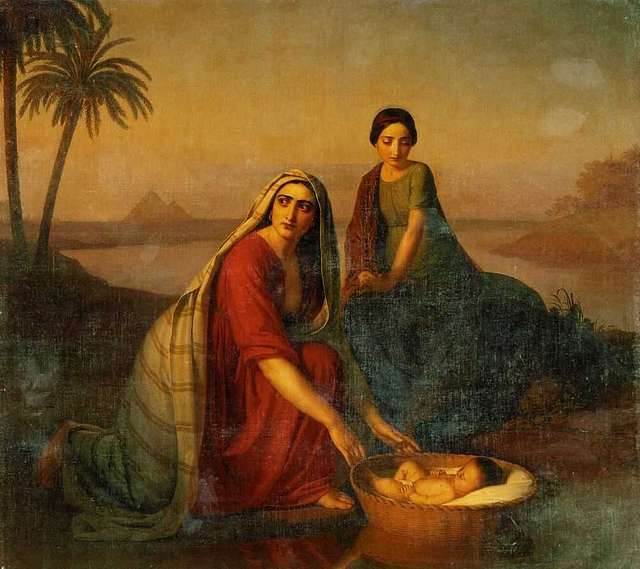
Hope remains alive in the hearts of the Hebrew people. Like Shiphrah and Puah, the mother of the child outwits the Pharaoh.1 In her hands, Earth elements of papyrus, bitumen and pitch become instruments of hope and liberation. She constructs a basket from these Earth elements, places her baby in the basket and places the basket among the reeds on the bank of the river. At this point, the baby boy’s unnamed sister enters the scene, a young woman of hope. She stands at a distance to see what might happen. In other words, she keeps an eye on her baby brother in the basket while living in hope that he will be rescued by an Egyptian person willing to claim him as her or his own. She witnesses the arrival of the Pharaoh’s daughter who comes to bathe in the river.
What happens at this point functions as a turning point in the story of the Israelite people. Pharaoh’s unnamed daughter sees the basket among the reeds, sends her maid to fetch it, opens it and sees the child who is crying. She not only sees, she also hears and responds. Her words, “This must be one of the Hebrews’ children,” leave the reader in no doubt: the daughter of Israel’s oppressor knows well that, in rescuing this child, she is disobeying her father’s command. She hears the cry of the abandoned child and thus ironically provides an image of the God of Israel who hears the cry of the poor. She is said to “pity” or “compassion” the child. It is the king’s daughter, rather than the royal father, who knows what it means to act both shrewdly and with compassion. The Hebrew verb translated as pity or compassion, ḥamal, can also mean to liberate or to set a captive free. This Hebrew or Israelite child is freed from oppression by the daughter of the oppressor. But that is not all. The Pharaoh’s daughter accepts the offer of the child’s sister to find a nurse from the Hebrew women “to nurse the child for you.” The sister, who, like her mother and the midwives, knows what it means to be shrewd, has understood that the oppressor’s own daughter intends to rescue this child. The baby is placed back in the arms of its mother, and the mother is paid wages to care for him. In other words, the household of the Pharaoh actually finances Moses’ family for the whole of his childhood. He is restored to his own family and, when he grows up, his mother brings him to Pharaoh’s daughter who “takes him as her son.” He eventually has two homes, the Hebrew/Israelite home of his birth and the royal court of the Pharaoh of Egypt. It is the Pharaoh’s daughter who calls him Moses, but not until he is an adult. The narrative leaves space for us, the readers, to be enriched by the many dimensions of our imagining, even to imagining what name his parents may have given him.
This story of lamentation to liberation has countless fictional elements. It simply could not have happened as recounted. The power of the story is that it happens all the time. There are ruthless oppressors in every age, some of whom think they have the monopoly on the wisdom needed to understand and to resolve the problems that confront their world until it becomes evident that the wisdom resides elsewhere, often among the oppressed or even in the households of the oppressors. This is a story of wisdom and of hope that is realized because those who hoped for the liberation of the child never abandoned the struggle. Hope in God does not disappoint.
Notes:
- For the initial impetus to reflect on this text as a story of women’s role in the liberation of God’s people, I am indebted to the wisdom I discovered in an article that I read some forty years ago. See J. Cheryl Exum, “’You Shall Let Every Daughter Live’: A Study of Exodus 1:8-2:10,” Semeia 28 (1983): 68-82.
- On the parallel in the story of the Mesopotamian monarch Sargon whose mother protected him by constructing a basket of bulrushes and casting the basket into the Euphrates River, see Rita J. Burns, Exodus, Leviticus, Numbers, Old Testament Message, Volume 3 (Wilmington, DE: Michael Glazier, 1983), 33.

image: “Moses Being Placed on the Waters of the Nile by His Mother” by Alexey Tyranov, c. 1839-1842.