
Job, the hero of the Book of Job, is held up as the quintessential model of patient endurance. Having the “patience of Job” is a proverbial expression that we use when we think of someone who can continue to bless God in the midst of the most horrific sufferings. The phrase “the Lord gave and the Lord has taken away, blessed be the name of the Lord” (Job 1:22) is well known. But perhaps most people’s knowledge of the story of Job comes from familiarity only with the prologue and the epilogue of the story, chapters 1-2 and chapter 42, verse 7 to the end of the book. These sections are written in prose as opposed to the body of the tale which is written in poetry. Although the story may be well known, the message or theology is not. Rather than being a Wisdom writing, it becomes an easy story that can induce guilt because we cannot measure up to Job’s patience in the midst of adversity. But was Job really patient or did Job have to work his way through to authentic conversion by engaging in lament? Did lamentation allow him to eventually pass through the pain to wisdom?
Gustavo Gutiérrez identifies the Book of Job as “one of the most passionate and beautiful books of the Bible.”1 Richard Rohr suggests that Job should be listed among the prophets rather than wisdom literature.2 However, the book is written to address one of the most fundamental human problems, that of the suffering of the innocent. Does such suffering come from God as punishment, retributive justice? This is certainly a critical question in our current world situation in which we see so much death and destruction, particularly in the Middle East. It is amazing how a literary piece written over 2,500 years ago can still be relevant to our current questions.3
The story of Job is a fictional story of an exceedingly rich man; our modern oligarchs would pale by comparison. His assets are listed in the prologue (7,000 sheep, 3,000 camels, 500 yoke of oxen, 500 she-donkeys) not counting seven sons, three daughters, and a very large household. He is also a God-fearing man, which in biblical understanding is code for a man of wisdom.4
One day, in heaven, there is a dialogue between God and a member of the heavenly court, the adversary or the satan.5 The purpose of the trials that will occur is to determine if Job’s righteousness is due only to the benefits he has received in his life. As a result, there are two trials in which Job loses all his possessions, his children and even his health. In addition, his wife condemns him and names the cause of his misery: he must have sinned, for such calamity can only be the result of his behavior. She upbraids him, “Are you still holding to your innocence? Curse God and die” (2:9)! In spite of all this suffering, Job maintains his sinlessness and remains faithful, “We accept good things from God, should we not accept evil” (2:10)?
Three friends, Eliphaz, Bildad, and Zophar come to comfort Job, but instead they increase his suffering because they try to help Job recognize and confess his sins so that the suffering will end. They represent the Deuteronomistic theology that sin or disobedience to God is the cause of sickness and calamity. Therefore, only true confession will reverse the suffering. But Job keeps proclaiming his innocence, which is one of the purposes of the tale, the suffering of the innocent. There is a series of nine speeches from the friends with eight responses from Job in which he keeps protesting his innocence. It is in Job’s responses that we encounter increasing lamentation. Each response is a lament, a complaint that it is God who is in the wrong, “Know that it is God who has dealt with me unfairly” (19:6). Fidelity to God is useless, “What do we gain by praying to God (Elohim)” (21:15)? So, Job decides he needs to confront God, “I want to argue with God” (13:3). Little does he know that he will get his wish.
In his suffering, Job goes through several stages of grief, bringing him to despair. First, he experiences the loss of control, “He has loosed my bowstring and afflicted me” (30:11), then to feelings of abandonment, “I cry to you, but you do not answer me” (30:20), then to depression “I go about in gloom without the sun” (30:29), and finally to grief, “My lyre is tuned to mourning and my reed pipes to sounds of mourning” (30:31). In desperation he lays down the gauntlet, “Let the Almighty answer me” (31:35).
At this point, a new character enters into the story. Elihu, who does function as a prophet, will be God’s defense attorney. Elihu is incensed by the inadequacy of the theological arguments of the three friends and frustrated by Job’s sense of self-righteousness. Elihu must defend God, “God is greater than mortals” (33:12).
Finally, God enters the conversation and accepts Job’s challenge to a duel. This is the moment of Job’s true conversion, but it happens in stages and there is some humor in the author’s description of the fight. God tells Job to “gird up your loins like a man” (38:3). Picture a Sumo wrestler with his loins girt entering the ring of competition. Poor Job doesn’t stand a chance. God now has the opportunity to speak and with a series of where, who, when, and what questions about the universe, nature, and animals, God begins to break down Job’s hubris. “Tell me if you know it all” (38:4, 18) seems to be dismissive of Job’s arguments during his long lamenting tirades. Job decides that his only option is to guard his tongue, “I put my hand over my mouth. I have spoken once, I will not reply, twice, but I will do so no more” (40:4b-5). I picture a child or anyone who just covers their mouth saying, “Oops.” This is not true acknowledgment of being in the wrong but rather an attempt to get out of a sticky situation.
Since this is not authentic conversion but simply giving in to a stronger opponent, there is a need for another round. Therefore, not surprisingly, we hear another command to Job to “gird his loins.” Round two begins and this time the questioning is about two mythical creatures, Behemoth and Leviathan, something that Job would have no knowledge of; he is totally out of his realm of knowledge. Finally, Job wakes up to his reality, his hubris has been pierced, it is gone and replaced by true humility. Job is finally converted and sincerely repents. “By hearsay I had heard of you but now my eye has seen you. Therefore, I disown what I have said and repent in dust and ashes” (42:5-6). Job now has clarity of vision, not just of the eyes but of the mind. Like John Newton,6 the former slave trader who became a minister and an abolitionist, wrote in his very well-known hymn, Amazing Grace, “I once was lost but now I’m found, was blind but now I see.” So, “to see” applies to our many moments of conversion and transformation.
So, does Lamentation have a constructive purpose? We too often think of it as just complaining, playing the blame game, an excuse for negativity, or a “poor me” syndrome. But, as we’ve seen from the story of Job, the Bible does recognize the validity of the human need to lament. For example, in the Book of Psalms, 43% (65 of the 150) are categorized as laments, and some can be shocking to our sensitivities.7 Lament is not necessarily an end in itself, but it may be a means to an end, honesty with oneself in order to finally be able “to see.” This is what it did for Job, so may it be so for us.
Notes:
- Gustavo Gutiérrez, On Job: God-Talk and the Suffering of the Innocent (Maryknoll, New York: Orbis, 1985), xvii.
- Richard Rohr, The Tears of Things (New York: Convergent, 2025), 92. Also Job and the Mystery of Suffering: Spiritual Reflections (New York: Crossroad, 2004).
- The dating of the Book of Job is an open question, although the majority opinion is that it is post-exilic, late 5th century BCE. The book is found in both Hebrew and Greek canons.
- “The fear of the Lord is the beginning of Wisdom.” Proverbs 1:7.
- Satan does not refer to the devil. He is a member of the heavenly court and is the tester or adversary of human beings. Even if Satan is capitalized, the presence of the article ‘the’ indicates it is not a name
- Newton was a slave trader who experienced a violent storm in 1748, an event which began his spiritual conversion which led to his giving up the slave trade until 1754 or 1755. He was ordained in the Church of England in 1764 and composed Amazing Grace in 1773.
- Psalm 137:9 is particularly harsh, which shocks many: “Blessed the one who seizes your children and smashes them against the rock.” The people have just had their temple destroyed and been brought out of Israel to Babylon into captivity. Therefore, the psalm is expressing the raw emotions of the Exile.

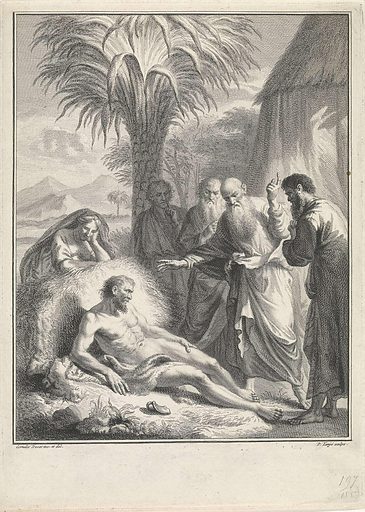
image: “Job On the Dung Heap” by Pieter Tanjé.