
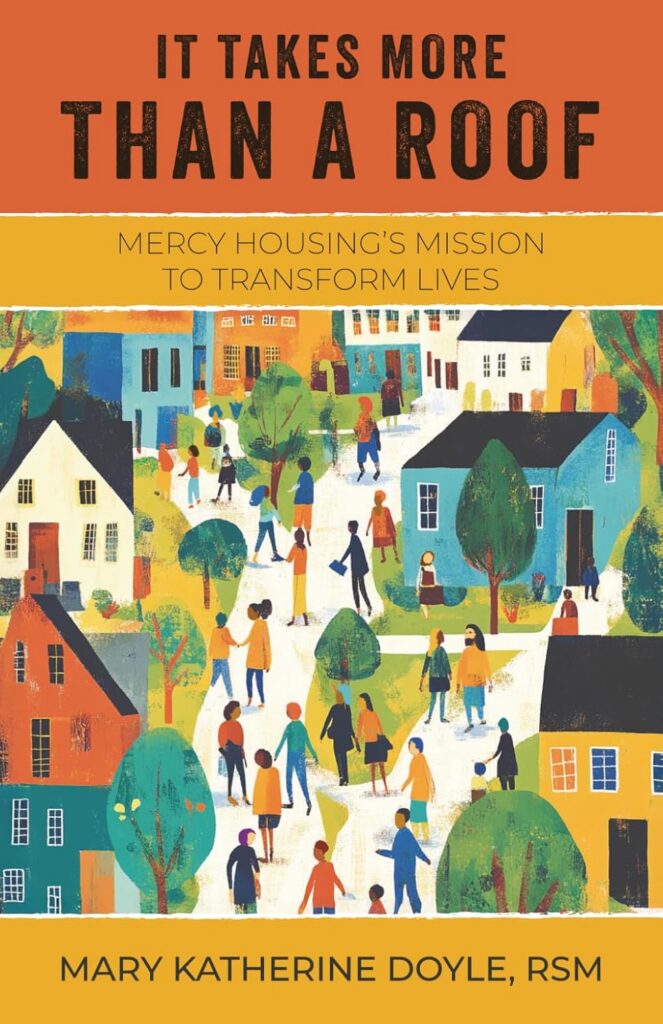
Perhaps because I have lived and ministered in New York since 1981, until I read Mary Katherine Doyle’s book It Takes More than a Roof: Mercy Housing’s Mission to Transform Lives, I had no idea the depth and scope of this wonderful ministry. Since its founding in 1981 Mercy Housing has provided housing and transformed the lives of more than 152,000 people by participating in the development, preservation, and/or financing of more than 48,200 affordable homes and providing “wrap-around” services to families, seniors, and people with special needs.
Author Mary Katherine Doyle, a Sister of Mercy trained as an historian, archivist, and spiritual director, is above all a storyteller. In this wonderful biography of Mercy Housing, she weaves stories that are inspiring, uplifting, and challenging. What could have been a stark recitation of facts comes alive in the stories of those who began and nurtured Mercy Housing as well as those who have benefitted from its work. There is nothing stark or dull about this book.
It all began with one woman’s frustration with bureaucracy. A Legal Aid Society lawyer, Patricia O’Roark (then Sister Timothy Marie), experienced first-hand how her clients’ substandard living conditions left them prey to unscrupulous landlords with little recourse and no access to affordable housing. Her response, “Lordy, I know we can do better than this” (accent on the WE) launched this amazing ministry. She was encouraged and supported by the 1975 National Conference of Catholic Bishops’ statement, “The Right to a Decent Home,” their pastoral response to the housing crisis then plaguing the country. Replete with staggering statistics that echoed O’Roark’s concerns, she shared her frustration with her superior, Sister Norita Cooney. They say timing is everything, and in this case that proved to be true. When the decision was made by the Union of the Sisters of Mercy to sell their Generalate in Bethesda, Maryland, each of the nine provinces was allotted a share of the proceeds for their priorities. Sister Norita encouraged O’Roark to submit a proposal to the 1980 Omaha Provincial Chapter to support her interest in housing ministry with the caveat to think BIG. Surely no one could have imagined just how big this dream would become once half a million dollars was designated to the cause.
Next, the Leadership Team needed to decide how the money should be used. Because O’Roark was not available to lead the work due to her responsibilities as Director of the Legal Aid Society of Northeast Nebraska, they invited a sister with extensive experience in Catholic Healthcare to take on this new challenge—creating a plan, assembling a team, and implementing the plan. The Task Force Sister Terese Tracy assembled included housing professionals, neighborhood organizers, attorneys, and interested province members. Including Jim Tomlinson, a real estate professional in Idaho, as a team member was a stroke of genius because he possessed all the skills and experience the rest of the team lacked, along with the wisdom and courage to think BIG.
As Doyle explains, Tomlinson “helped the sisters learn how to manage properties themselves as well as how to leverage their money and develop on a large scale . . . and strongly believed it was important for them to own properties, not just manage them.”1 Yes, ownership was surely key to Mercy Housing’s success. Tomlinson enabled them to purchase properties through a syndication process in which a group of investors pool their capital to purchase large properties. He also helped them develop skills in property management by having his company manage the properties until the sisters were ready to take over. Sister Terese also found internships all over the country where her pioneers could gain knowledge and experience.
Because obtaining additional money was essential to Mercy Housing’s growth, they partnered with a real estate investment company to find investors willing to participate in this project. While this worked well initially, it turned out the partner was more interested in profit than service, a significant lesson in the need for congruence in values and mission. In 1983, what is now known as Mercy Community Capital was established to secure resources not only for Mercy Housing, but also for other agencies and organizations at work in providing housing for those in need with the shared goal of systemic change.
What began with the Omaha Province soon expanded to include the independent regional California Mercy communities of Auburn and Burlingame. Other partnerships followed, first with Catholic Charities and then with other religious communities. New co-sponsors broadened Mercy Housing’s geographical reach and required the establishment of regional offices. Today, Mercy Housing has five regional offices in addition to its headquarters in Denver: California; Lakefront, serving the Great Lakes area; Mountain Plains, serving those struggling in the middle of the country in cities like Denver, Omaha, and Phoenix; Northwest, with services in Washington, Oregon and Idaho; and Southeast, with 44 properties throughout Alabama, Georgia, Kentucky, North Carolina, Ohio, South Carolina, and Tennessee, in addition to its subsidiary Mercy Capital, its Community Development Financial Institution (CDFI) mentioned earlier.
According to its 2025 Community Report,2 since 1981 Mercy Housing has invested $6.5 billion in affordable real estate. Its 360 properties across 21 states provide 27,408 apartment homes to 41,817 people. They are served by 1,793 staff and administrators dedicated to creating “vibrant, program-enriched communities where families, seniors, veterans, and individuals can put down roots and thrive.” In the pages of It takes More Than a Roof and on the Mercy Housing website (https://mercyhousing.org) you can read and learn about the amazing stories that run counter daily news reports. When respect, justice, and mercy guide every decision, hope abounds.
Notes:
- Mary Katherine Doyle, It Takes More Than a Roof (Denver: Mercy Housing, 2026), 33.
- https://community.mercyhousing.org/