
The following article is reprinted with permission of Pastoral Review where it was first published in Vol. 21 Issue 2 (April/May/June 2025) 51-55. The article formatting style reflects that of the original.
In May 2024, when an American television reporter asked Pope Francis if a woman could be ordained a deacon, he answered, ‘No. If it is deacons with holy orders, no. But women have always had, I would say the function of deaconesses without being deacons, right? Women are of great service as women, not as ministers. As ministers in this regard. Within the Holy Orders.’[1]
Pope Francis is wrong, and the Synod on Synodality knew that. Its now Magisterial Final Report directly calls for further study. Not long ago, Cardinal Walter Kasper told the international Catholic journal Communio that the diaconal ordination of women was theologically possible and pastorally sensible: ‘Each local church would be free to decide whether or not it wanted to make use of this possibility or not.’[2]
The Synod
The 2021–4 Synod on Synodality produced the now-Magisterial Final Document, ‘For a Synodal Church: Communion, Participation, Mission’, which is more about a conversion to a new way of understanding the Church as a Church on mission, with emphasis on the principle of subsidiarity, as below:
A synodal reflection on the exercise of the Petrine ministry must be undertaken from the perspective of the “sound decentralization” (EG 16) wanted by Pope Francis and many Episcopal Conferences. According to the Apostolic Constitution Praedicate Evangelium, this decentralization means “to leave to the competence of Bishops the authority to resolve, in the exercise of ‘their proper task as teachers’ and pastors, those issues with which they are familiar and that do not affect the Church’s unity of doctrine, discipline and communion, always acting with that spirit of co-responsibility which is the fruit and expression of the specific mysterium communionis that is the Church (PE II, 2)[3]
The diaconate
The Final Report recommends local churches ‘not to delay in promoting the permanent diaconate more generously’[4] and points out that: 1) deacons are not ordained to the priesthood, but unto a ministry of service; 2) they exercise their service by the proclamation of the Word, the liturgy, and charity; 3) they have many ways of service, specifically in the liturgy and in what the document calls “pastoral practice”; 4) they work in service to the local church.
The history of the diaconate includes women, from the earliest mention in Scripture of Saint Phoebe (Rom. 16.1–2). Deacons, male and female, are known up to and including part of the twelfth century, East and West, although the cursus honorum (course of honour) restricting diaconal ordination to those men destined for priesthood eventually effectively ended the diaconate as a permanent vocation.
The Council of Trent attempted to restore the diaconate, but only managed at its twenty-third session to restore its distinct functions along with those of the minor orders, without ending the cursus honorum.[5] What is most interesting is that Trent attempted to do in the sixteenth century what Francis is partially attempting to do now: restore the functions of the four minor orders and the major order of subdeacon through the installed offices of lector and acolyte, now to include women. Trent left consideration of the sacramentally ordained order of deacon to the popes.
In 1957, Pope Pius XII spoke about the diaconate as a permanent vocation, but said ‘Today, at least, the idea is not yet ready for application.’[6]
While the Second Vatican Council restored the diaconate as a permanent vocation, two Council Fathers, Peruvian Bishop León Bonaventura de Uriarte Bengoa, OFM (1891–1970), and Bishop Giuseppe Ruotolo (1898–1970) of Ugento, Italy, brought the restoration of women to the diaconate to the Council. No action regarding women ensued.[7]
Women
The 2021–4 Synod on Synodality took up the question. The final document of the initial, 2023, Synod meeting stated:
Different positions have been expressed regarding women’s access to the diaconal ministry. For some, this step would be unacceptable because they consider it a discontinuity with Tradition. For others, however, opening access for women to the diaconate would restore the practice of the Early Church. Others still, discern it as an appropriate and necessary response to the signs of the times, faithful to the Tradition, and one that would find an echo in the hearts of many who seek new energy and vitality in the Church. Some express concern that the request speaks of a worrying anthropological confusion, which, if granted, would marry the Church to the spirit of the age.[8]
The 2023 Synod asked:
Theological and pastoral research on the access of women to the diaconate should be continued, benefiting from consideration of the results of the commissions specially established by the Holy Father, and from the theological, historical and exegetical research already undertaken. If possible, the results of this research should be presented to the next Session of the Assembly.[9]
However, women deacons were not on the official agenda for the October 2024 Synod. In June 2024, the Synod Office released the membership of 15 study groups, five on processes of Synodality and ten on specific topics, including one on women in ministry.[10]
The ten topical study groups presented reports on the first day of the 2024 assembly. The reports were three-minute briefs on the works of individuals whose identified photographs appeared simultaneously on screens at home and in the Paul VI Aula. The only outlier was the report of Study Group Five, titled ‘Some theological and canonical issues around specific ministerial forms (summary report 8 and 9)’, headed by Father Armando Matteo, the 54-year-old Italian Undersecretary for Doctrine of the Dicastery for the Doctrine of the Faith.
However, Matteo did not present the report of Study Group Five. Rather, Cardinal Victor Fernandez, Argentinian prefect of the Dicastery for the Doctrine of the Faith, presented it, at one point digressing from the published text, which states ‘based on the analysis conducted so far … the Dicastery judges that there is still no room for a positive decision by the Magisterium regarding the access of women to the diaconate, understood as a degree of the sacrament of Holy Orders’.[11]
Cardinal Fernandez said:
[W]e know the Pontiff’s public position that he does not consider the issue mature. The opportunity for further study remains open, but in the Holy Father’s mind here are other issues that still need to be explored and resolved before rushing to talk about a possible diaconate for some women. Otherwise, the diaconate becomes a kind of consolation [prize] for some women and the more decisive question of women’s participation in the church remains neglected.
Fernandez then listed lay female exemplars of service: eight canonized saints, one popular ‘saint’, three whose canonization proceedings are ongoing, and the most influential female political figure in medieval Italy. Specifically, he named four Italians, two Germans, one Swede, two French, one Mexican, one Argentinian, and two Americans. All lived after the essential demise of the diaconate as a full and active order in the Latin Church.[12]
They are certainly exemplary persons, but their ‘diaconal’ work is not what those called to the diaconate today – men and women – are thinking about. For example, the first woman on the list is Matilda of Canossa, who ruled over a significant portion of Italy during the second half of the eleventh century, supported papal political and military activities and was the first woman buried in St Peter’s Basilica. Somehow the Dicastery for the Doctrine of the Faith connects her and the other women with, as Fernandez said,
completing a reflection of the expansion of the Church’s ministerial dimension in light of her charismatic dimension, to suggest the recognition of charism or the establishment of roles of ecclesial service that – while not directly connected to sacramental power – are rooted in the Sacraments of Baptism and Confirmation.[13]
One wonders what this means. Do the women who ask to be ordained as deacons need to think about ruling over a third of Italy? Do they need to invent such a spectacular life that they will be in line for sainthood?
Fernandez’ commentary ends:
In the light of these beautiful testimonies, the question of women’s access to the diaconate takes on a different perspective. Meanwhile, the in-depth study of their multifaceted Christian witness can help us today imagine new forms of ministry that can “create still broader opportunities for a more incisive female presence in the Church.”[14]
Cardinal Fernandez’s comments, and the fact that instead of photos of the Group Five members, the screens in the Paul VI Aula flashed one photo of the entire Dicastery staff, and another of its senior members, confused the issues and angered many people.
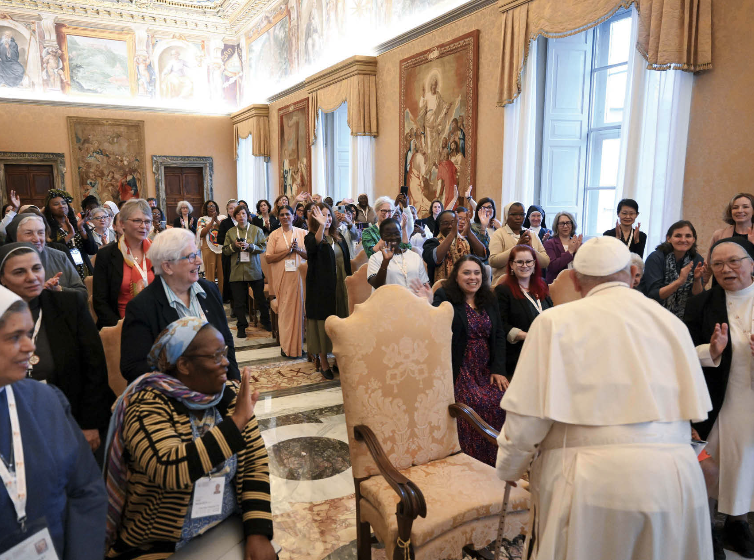
The rumblings in the Synod hall echoed far beyond it. Women deacons were not on the agenda, but by eliminating the topic, the question of women deacons became the focal point of many interventions and much discussion. Within a few days, the Synod Office announced that members could sign up to meet with the Study Groups on the afternoon of 18 October, a Friday.
Approximately one hundred members attended the Study Group Five meeting. They were met not by Cardinal Fernandez, nor by Father Matteo, but by two staff members of Doctrine of the Faith, a young American polyglot priest, Father Andrew Liaugminas, and Dott. Veronica G. Casillas Patrón, identified as a ‘technical worker’ in the Vatican’s Annuario Pontificio, who introduced themselves only by their first names.
They were unable to answer questions and asked those in attendance to line up and receive a slip of paper that invited them, in six languages, to submit their written opinions to an email address.[15]
Their dismay spilled over to a hastily planned meeting with Pope Francis that following Sunday, originally scheduled to be for a core group of 12 or 15 women Synod members, but which included most of them. By Monday, Cardinal Fernandez spoke, saying that Father Matteo’s medical appointment made him unable to attend the Friday meeting, but did not explain his own absence. He announced that the Second Pontifical Commission for the Study of the Diaconate of Women would resume its work, all the while insisting that women’s leadership in the Church should not be linked to ordination.
Cardinal Fernandez also announced a second meeting, at which he would provide a full list of the members of Study Group Five, this one for Thursday 24 October at 4:30 p.m. Rome time. The date and time are important, because by the end of the third week of the Synod, the Final Report was well into the drafting process, and the final paragraph-by-paragraph vote was scheduled for the Synod’s final session on 26 October.[16]
Vatican News took the quite unusual step of recording the entire meeting and making the audio available. Two of the questions from among the one hundred persons present stand out. Jesuit Father Agbonkhianmeghe E. Orobator, dean of the Jesuit School of Theology at Santa Clara University, addressed the delay in deciding about women deacons, and asked when the time would be ‘ripe’, implying that when the time is over-ripe, like fruit, the question spoils, and rots. Another, by American sociologist Dr Trisha Bruce, echoed his theme. She reported that among her sociological studies, two stood out concerning the question of women deacons. Her survey of young priests found them excited and happy in their vocations, willing to encourage other young men to follow them. Her survey of young women involved in lay ministry asked their advice for women considering a vocation within the Church. Their singular, unified answer was ‘run away’.[17]
It is still unclear who belongs to Study Group Five, except Armando Matteo and Cardinal Fernandez. The question – or more likely the completed document – will go before the Consultors to the Dicastery for the Doctrine of the Faith, including the 28 persons appointed in September 2024. That group is comprised predominantly of Italian priests, two other men, and six women, and includes three members of the initial Pontifical Commission for the Study of the Diaconate of Women, Professor Nuria Calduch, Monsignor Piero Coda, and Professor Michaelina Tenace. The members of the Second Commission met in Rome 3–7 February 2025, presumably to consider the Synod members’ contributions.
The Study Groups are supposed to provide their final reports by June 2025. Will a document on women deacons affirm the tradition of ordaining women as deacons? Or will it create a new non-ordained lay ministry of deaconess? Perhaps, to echo both Pope Pius XII and Cardinal Fernandez, the question is not mature, the time is not ‘ripe’.
The Synod’s Final Report affirms the following:
By virtue of Baptism, women and men have equal dignity as members of the People of God. However, women continue to encounter obstacles in obtaining a fuller recognition of their charisms, vocation, and roles in all the various areas of the Church’s life. This is to the detriment of serving the Church’s shared mission. Scripture attests to the prominent role of many women in the history of salvation. One woman, Mary Magdalene, was given the first proclamation of the Resurrection. On the day of Pentecost, Mary, the Mother of God, was present, accompanied by many other women who had followed the Lord. It is important that the Scripture passages that relate these stories find adequate space inside liturgical lectionaries. Crucial turning points in Church history confirm the essential contribution of women moved by the Spirit. Women make up the majority of churchgoers and are often the first witnesses to the faith in families. They are active in the life of small Christian communities and parishes. They run schools, hospitals, and shelters. They lead initiatives for reconciliation and promoting human dignity and social justice. Women contribute to theological research and are present in positions of responsibility in Church institutions, in diocesan curias and the Roman Curia. There are women who hold positions of authority and are leaders of their communities. This Assembly asks for full implementation of all the opportunities already provided for in Canon Law with regard to the role of women, particularly in those places where they remain under-explored. There is no reason or impediment that should prevent women from carrying out leadership roles in the Church: what comes from the Holy Spirit cannot be stopped. Additionally, the question of women’s access to diaconal ministry remains open. This discernment needs to continue. The Assembly also asks that more attention be given to the language and images used in preaching, teaching, catechesis, and the drafting of official Church documents, giving more space to the contributions of female saints, theologians and mystics.[18]
Let us look to female saints, theologians, and mystics. Recall Cardinal Fernandez pointed to several lay women as exemplars for women’s ministry. They were queens and princesses, foundresses, political leaders, and mystics, all wonderful and exemplary women. He did not name Saint Phoebe.
[1] ‘Pope Francis Interview with Norah O’Donnell’, Columbia Broadcasting Network (20 May 2024) at 23:15, https://www.rev.com/blog/transcripts/pope-francis-interview-with-norah-odonnell, accessed 16 January 2025.
[2] Walter Kasper and Jan-Heiner Tück, ‘A synod is not a theological congress’, Communio 31 (October 2024), https://www.herder.de/communio/theologie/walter-kardinal-kasper-im-gespraech-ueber-die-weltbischofssynode-in-rom-eine-synode-ist-kein-theologenkongress-/, accessed 16 January 2025.
[3] Francis, XVI Ordinary General Assembly of the Synod of Bishops, ‘For a Synodal Church: Communion, Participation, Misson, Final Document’, Vatican City (24 November 2024), paragraph 134. Citing Evangelii Gaudium.
[4] ‘Final Document’, paragraph 73.
[5] Twenty-third Session of the Council of Trent (15 July 1563), Chapter XVII, https://www.ewtn.com/catholicism/library/twentythird-session-of-the-council-of-trent-1490, accessed 16 January 2025.
[6] Pius XII, Guiding Principles of the Lay Apostolate: Address of His Holiness Pope Pius XII to the Second Congress of the Lay Apostolate October 5, 1957, Washington, DC: National Catholic Welfare Conference, 1957; also, Pius XII, Discourses and Radio messages, vol. XIX, pp. 455–73; https://www.papalencyclicals.net/pius12/p12layap.htm, accessed 16 January 2025.
[7] Acta et documenta Concilio oecumenico Vaticano II apparando; Series prima (antepraeparatoria) (Typis Polyglottis Vaticanis, 1960–1) (ADA), II/II, 121.
[8] First Session, ‘A Synodal Church in Mission, Synthesis Report’, 9, j.
[9] First Session, ‘A Synodal Church in Mission, Synthesis Report’, 9, n.
[10] H. Brockhaus, ‘These are the members of the Synod on Synodality study group’, Catholic News Agency, 9 July 2024. https://www.catholicnewsagency.com/news/258224/these-are-the-members-of-the-synod-on-synodality-study-groups, accessed 16 January 2025.
[11] Second session, XVI General Ordinary Assembly of the Synod of Bishops, ‘Presentation of the Reports of the 10 Working Groups Established by Pope Francis, Group 5, Some Theological and Canonical Matters Regarding Specific Ministerial Forms (SR 8 and 9)’, 2 October 2024.
[12] Matilda of Canossa, Hildegard of Bingen, Bridget of Sweden, Catherine of Siena, Joan of Arc, Teresa of Ávila, Juana Inés de la Cruz, Mama Antula, Elizabeth Ann Seton, Maria Montessori, Armida Barelli, Dorothy Day, Madeleine Delbrêl.
[13] Fernandez, Group 5 Presentation. Citing Evangelii Gaudium 103.
[14] Ibid.
[15] Christopher White, ‘Outrage follows Vatican doctrine chief’s absence from synod meeting on secretive women’s study group’, National Catholic Reporter, 16 October 2024. https://www.ncronline.org/vatican/vatican-news/outrage-follows-vatican-doctrine-chiefs-absence-synod-meeting-secretive-womens, accessed 16 January 2025.
[16] Christopher White, ‘Vatican doctrinal czar says women deacons commission will resume work’, National Catholic Reporter, 21 October 2024. https://www.ncronline.org/vatican/vatican-news/vatican-doctrinal-czar-says-women-deacons-commission-will-resume-work, accessed 16 January 2025.
[17] Andrea Tornielli, ‘Cardinal Fernández: Let us work to give women more space and power’, Vatican News, n.d., https://www.vaticannews.va/en/vatican-city/news/2024-10/fernandez-let-us-work-to-give-women-more-space-and-power.html, accessed 16 January 2025.
[18] ‘Second Session Final Document’, paragraph 60, (Unofficial translation), Emphasis mine.
This article is reprinted with permission of Pastoral Review where it was first published in Vol. 21 Issue 2 (April/May/June 2025) 51-55. It is adapted from Zagano’s Mary Ward Lecture at the Margaret Beaufort Institute of Theology, Cambridge University on 15 November 2024.

image: Independent Photo Agency SRL / Alamy