
Book Review: Courage & Compassion: Sisters of Mercy in the American Civil War
Paula Diann Marlin, RSM
Palmetto Publications (2024)
One of the marks of a good historical study is its ability to leave the reader wanting more. Paula Diann Marlin, RSM, has done just that in her book Courage & Compassion Sisters of Mercy in the American Civil War. Published in 2024 by Palmetto Publications, the book recounts the work of the Sisters of Mercy during the United States Civil War (1861-1865) that would result in the abolition of slavery. Marlin expands the work begun by such books as Nuns on the Battlefield and To Bind Up the Wounds: Catholic Sister Nurses in the U.S. Civil War. She gathers in one volume the sometimes-overlooked story of Sisters of Mercy living in the midst of war.These dauntless sisters cared for soldiers on both sides of the conflict, offering medical care and spiritual comfort regardless of religion, race, or beliefs.
Courage & Compassion is a user-friendly book. Marlin has divided the work into five parts.
Part 1 provides context for the story which opens a window for readers into the Mercy tradition of compassionate care for the sick as well as the cultural setting in which the Civil War emerged.
Chapter 5 on “The Quality of Medical Care,” is of significant help in understanding the circumstances and challenges faced by Mercy’s “sister-nurses.” In a period of high-tech medicine, it is difficult to imagine the type of medical environment encountered by the sisters who served in Civil War hospitals and infirmaries. Marlin helps readers to visualize that environment by inclusion of vivid quotations from other Civil War sources:
The field was littered with bloody, mangled bodies with no on-site medical assistance available…Thousands of wounded Federals struggled back to Washington. “some walked, some crawled, and the lucky ones were dumped into Good Samaritan’s springless wagons…” the living squirmed among the dead.[1]
Marlin explores other dynamics further illustrating the challenges faced by the sister-nurses. Here are a few examples:
- bullets were made to be penetrating and crippling which resulted in severe trauma;
- medical practitioners had rudimentary knowledge regarding sanitation, germs, nutrition and contagion;
- women nurses were generally not trusted; and
- there was an overall lack of resources and trained medical personnel.
Marlin points out that a high percentage of deaths were due, in fact, to disease – not battle.
Perhaps the most striking detail, Marlin notes, was the sheer volume of wounded and dying. The Union, representing the northern United States) lost 225,000 soldiers while the Confederacy, representing the southern United States) lost 164,000.
Parts 2–4 take the reader on a compelling journey through the varied experiences of Mercy sister-nurses during this tumultuous time. Filled with vivid anecdotes taken from existing memoirs, journals, diaries and reports of the period, readers get a firsthand view of the horrific circumstances within which the sisters performed their duties. Descriptions of filth, untended wounds, uneatable food, and primitive medical care are found in the stories of all the various Mercy communities engaged in wartime nursing.
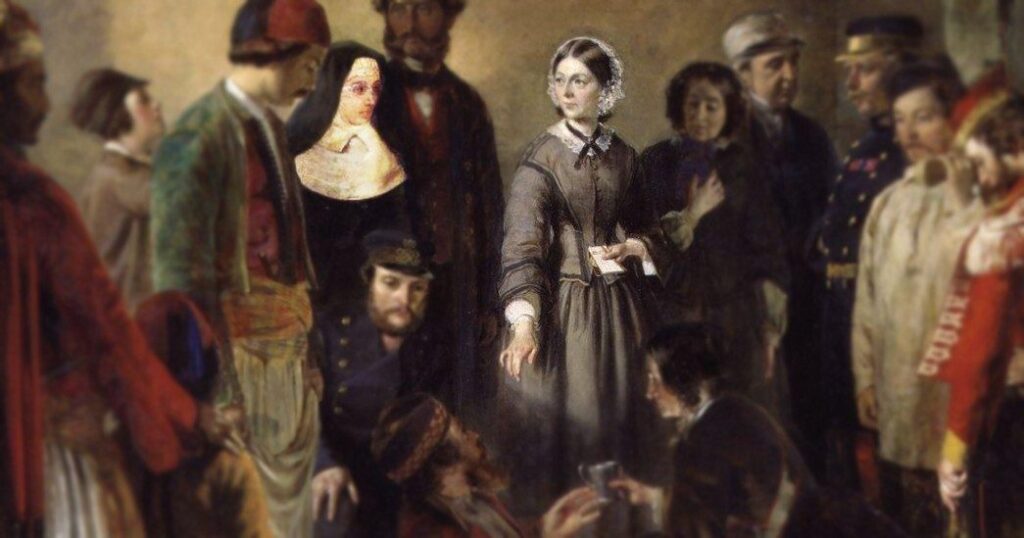
In contrast to the circumstances typical of wartime “field medicine”, Marlin provides story after story of sisters bringing strict cleanliness standards into chaos, jumping in to clear away mud, debris, moldy food, and blood-soaked linens. The sister-nurses uniform approach is referred to so often, it is reasonable to hypothesize that all the sisters shared a Mercy style of nursing. Some sisters were veterans of the Crimean War (1853 – 1856), and likely that model of nursing transferred itself into the U.S. American context.
The ten communities researched by Marlin are divided into three theaters[2]: The Eastern Theater, The Western Theater, and the Southern Theater. This regional approach to the story provides two important elements. First, it allows the reader to understand the interaction between local cultures and military actions. Second, it provides insight into geographic aspects which factored into the battles. Those geographic elements ran the gamut from rivers to mountains, swamp lands to urban settings. These same aspects shaped the ways in which sisters engaged in the conflict.
Each regional theater of the war had its own unique character. While all areas experienced medical paucity, lack of resources and unsanitary conditions, the cultural environments were vastly different. Marlin’s chapters on the Eastern Theater describe how the sisters were accepted as skilled nurses and respected for their service. Military and civil leaders did not hesitate to place hospital facilities under the supervision of the sisters. Additionally, the sisters’ home bases, e.g., Pittsburgh and New York, were more sheltered from the front lines, and the facilities were not shaken by the direct shelling and attacks. This unfortunately was not true in the Southern Theatre which had to content with not only the sick, wounded, and dying, but also with the constant danger of attack.
While sister-nurses in the Eastern Theater were welcomed and even sought after by government officials, it was a different story in the Western Theater which included the areas around Chicago, Cincinnati, and St. Louis. Appreciation for the role of women in healthcare was not yet part of the culture in these areas, and some sisters were prohibited from administering the medical care for which they were well-trained and instead limited to providing spiritual comfort and attending to personal needs of the soldiers. That was initially true for the Cincinnati contingent despite the fact that some sister-nurses were veterans of the Crimean War.
The Eastern Theatre was predominantly stationary, meaning the care for the sick, wounded and dying was in stable locations. Marlin notes that the Western Theater, by contrast, was much more mobile in that the sister-nurses moved with the carnage of the war. They did not have the stability, safety, or resources of a “home base” and were constantly adapting. Again, Marlin’s use of abundant anecdotes makes the narrative come alive and invites the reader to enter into the scenes.
The final theater, the Southern Theater, provides yet another face of the sisters’ involvement in the war. Marlin shows us a scenario in which war comes to the sisters. Established hospitals were not the only place they volunteered to serve. Their convents, schools and other buildings were transformed into refuges for the wounded. Describing the realities of the time, the author paints a picture of the sisters sharing in the losses and privations of the civic communities in which they lived. Everyone hungered; everyone had to deal with loss. Chapter 13, on the siege at Vicksburg, vividly shows the role that the land itself played in shaping battles lost and battles won.
Like their sisters serving in the Western Theater, the sister-nurses of the Southern Theater were often met with suspicion, coldness, or outright hostility. That attitude was transformed by the power of witness. Over and over again, the book recounts details of such transformations as well as the impact the compassion of the sisters had on their patients and collaborators. Without directly saying it, Marlin shows how the sister-nurses of the Civil War willingly embraced the cross of suffering, deprivation, and personal risks without thinking it extraordinary or more than they were called to do. Lived mercy permeates the whole text.
While Parts 2-4 constitute the heart of the book, Part 5, the epilogue, opens up deeper questions. The role of Sisters during the civil war was a significant factor in winning acceptance for Catholicism in sectors that were previously hostile to Catholics. The book invites readers’ curiosity about learning more about this dynamic. In calling attention to the power and significance of the silent witness of the sister-nurses, Marlin also opens up a question for not only the Sisters of Mercy of today but for us all: how have our lives and works of mercy impacted others and the world? What does that impact look like in this time and culture? How do people today see us as “angels of mercy?” Another thread worth exploring is the relationship between the power of person and competency and effecting change. The sisters had no official roles but, as is pointed out in the narrative, they were able to advocate for and obtain needed resources and changes to aid those who were sick, wounded and dying. They spoke truth to power.
This is a work that is inspirational and challenging. Marlin’s Courage and Compassion lifts up a story that is compelling and real. It is well worth the read.
[1] Paula Diann Marlin, RSM, Courage & Compassion: Sisters of Mercy in the American Civil War (Palmetto Publications, 2024) 42.
[2] The word “theater” is used to describe geographic regions of significant military activity.

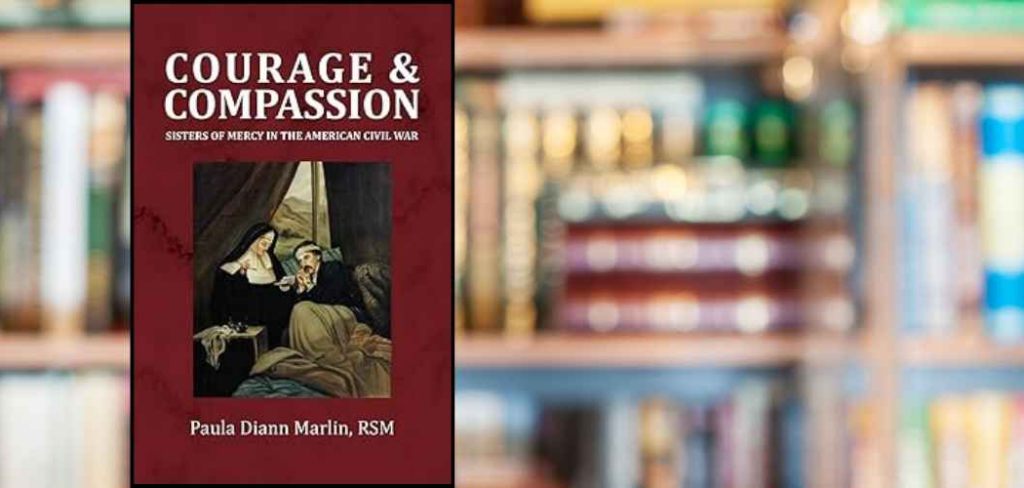
image: Book cover of Courage & Compassion:
Sisters of Mercy in the American Civil War
via Mercy Education