
Introduction
In 2021, Pope Francis issued two apostolic letters in the form of motu proprio,on the subject of instituted ministries. The first, Spiritus Domini[1] (10 January 2021), amended canon 203.1 of the Code of Canon Law, formally giving women access to the instituted ministries of lector and acolyte. The second, Antiquum ministerium[2](10 May 2021), instituted the ministry of Catechist.
You might be reading this thinking – so what’s new here? Women have been ministering as lectors, acolytes and catechists for many years. The distinction is in the term “instituted” rather than “deputed”. Shortly after Vatican II and up until the promulgation of Spiritus Domini, instituted ministries of lector and acolyte were only open to men moving toward Holy Orders. These instituted ministries were conferred by a bishop within a liturgical rite. In the absence of instituted lectors and acolytes, women and men lay faithful were “deputed” or commissioned to proclaim the Word of God, distribute communion and serve at the altar.
Some may view this papal acknowledgement of the ministry of catechists and the formal inclusion of women as acolytes and lectors as “overblown and disingenuous to the reality of practice over the past half century”.[3] This article will not argue that point. Rather, within the limits of this reflection we will focus on the organic development of the role of instituted lector to mine a theology of ministry of all baptized believers and the centrality of the Word of God in the mission of the Church. What fresh insights can be gained in moving ahead toward the goal of building up the Body of Christ? Does Francis’ apostolic letter signify “too little, too late” or “wonderful complexity”[4]?
Organic development
1. New Testament witness
New Testament scholar George Smiga succinctly states that the work of proclaiming the Gospel was from the beginning the work of the entire Church.[5] The Acts of the Apostles and Pauline letters repeatedly demonstrate that the diversity of gifts received from the Spirit was an inclusive calling, for the purpose of building up the church. “There are different kinds of spiritual gifts but the same Spirit…. To each individual the manifestation of the Spirit is given for some benefit” (1 Corinthians 12: 4-7).[6] In the letter to the Ephesians, Paul further elaborates upon gifts and calls as rooted in a shared baptismal identity: “… one body and one Spirit … one faith, one baptism, one God and Father of all, who is over all and through all and in all”. (Ephesians 4:4) “But grace was given to each of us according to the measure of Christ’s gift.” (Ephesians 4:7) “And he gave some [gifts] as apostles, others as prophets, others as evangelists, others as pastors and teachers, to equip the holy ones for the work of ministry, for building up the body of Christ.” (Ephesians 4:11-12) And in the letter to the Galatians, Paul reminds the community that identity in Christ is now the determining factor. “There is neither Jew nor Greek, there is neither slave nor free person, there is not male or female; for you are all one in Christ Jesus.” (Galatians 3:28)
In Romans 16:1-15, Paul offers an insightful glimpse into an inclusive call to ministry in the early church in which he addresses greetings to the followers in Rome who shared his work of proclaiming the gospel. Among them are:
- “Phoebe, our sister, who is also a minister of the Church in Cenchreae” (vs.1)
- Urbanis, Mary, Prisca and Aquila, co-workers, the latter two being hosts and leaders of a house church
- Andronicus and Junia “my relatives and my fellow prisoners; they are prominent among the apostles and they were in Christ before me” (vs. 7)
In another passage Paul believes that “apostles” held first place in the Church (1 Corinthians 12:28)
Of the 29 collaborators mentioned in Romans 16:1-15, nine are women. This list also includes married couples.
These few passages provide a window of reflection for us today. The early Christians understood that diverse gifts and charisms manifested among believers had their source in God and are rooted in baptism. Ministry to proclaim the Good News of Jesus Christ is inclusive of both male and female as co-workers. Furthermore, the importance of proclaiming the Word of God and teaching is for the benefit of building up the body of Christ.
Although the prominence of this biblical foundation for a theology of ministry has been interpreted and practiced in various ways throughout the history of the Latin Church, a return to this biblical witness set a precedent for Pope Paul VI and later Pope Francis to adapt and reorient a theology of ministry in the wake of Vatican II.
2. Ecclesial shifts of reality, perspective and practice
Theological shifts promulgated by the documents of Vatican II prompted a renewed sense of the universal call to holiness (Lumen gentium §39), the call to full, conscious, active participation in the liturgy by reason of baptism (Sacrosanctum concilium §14), the nature of the Christian community as missionary (Ad gentes §15) and the role of the church in the modern world as responding to the signs of the time, adapting to varying circumstances in light of the Gospel (Gaudium et spes §4).
a. Paul VI, Ministeria Quaedam (1972)
With this in mind, Pope Paul VI in consultation with bishops’ conferences and the opinion of experts, took the step to revise and suppress the ecclesiastical functions of first tonsure, the minor orders and the sub-diaconate. In the 1972 apostolic letter Ministeria quaedam,[7] the pontiff notes that the minor orders of porter, reader, exorcist and acolyte had originally been entrusted to the lay faithful but over time had slowly come to be considered (in many areas) as a training in preparation for the reception of holy orders. Based on this history of practice not doctrine, he deemed “it… fit to reexamine this practice and adapt it to contemporary needs.”[8]
Hence, by his apostolic authority, Paul VI enacted the following norms: the offices of reader and acolyte are to be preserved and adapted since they are more closely connected with the ministries of the word and altar. Their conferral will be by “institution” not ordination. As a result, minor orders were suppressed and the two offices of lector and acolyte were called “ministries” since they may be assigned to lay Christians. This arrangement, explained Paul VI, brings out more clearly the distinction between laity and clergy but also mutuality by which the “universal priesthood of believers and the ministerial priesthood, though they differ… in essence and not only in degree, are nonetheless interrelated… sharing in the one priesthood of Christ.”[9]
Paul VI listed the duties of the reader in particular: 1) to proclaim the Word of God in the liturgical assembly (except for the Gospel) and 2) to prepare other faithful deputed to proclaim the Scriptures on a temporary basis. In order to fulfill these duties more fittingly, the instituted reader is to meditate assiduously on Sacred Scripture and make every effort to acquire a living love and knowledge of Scripture so as to become a more perfect disciple of the Lord.[10]
Lastly, Paul VI issues the norm that “in accordance with the ancient tradition of the Church, institution to the ministries of reader and acolyte is reserved to men”[11] and should be conferred by the Ordinary (bishop, and in clerical institutes, the major superior) through a liturgical rite. Necessary changes to the Code of Canon Law were promulgated through Paul VI’s motu proprio.
The precedent set by Paul VI in Ministeria quaedam through the lens of New Testament biblical witness and the emerging theology of Vatican II, set in bas-relief ecclesial change guided by organic progression.A rationale justified by evolving ancient tradition, ministry rooted in baptismal identity and common good, and the urgency of Gospel witness today was the impetus to change practice but also appealed to the imagination to vision anew.
b. Pope Francis and Spiritus domini (May 2021)
In 2021, Francis took the occasion of the fiftieth anniversary of Ministeria quaedam to once more consider the subject of ministries undertaken by Paul VI and issued his own motu proprio, Spiritus domini.[12] Mandating a change in canon law, women are now admitted to instituted ministries of lector and acolyte.[13] We might ask what provoked this apostolic letter after fifty years.
In an explanatory message on the 50th anniversary of Ministeria quaedam, Francis highlights the evolving changes in ecclesial reality, concrete life situations and doctrinal understandings, to make evident the fact that the exercise of ministries in the Catholic Church has assumed different forms while still retaining the distinction between “instituted” (or lay) ministries and the “ordained” ministries.[14]
Naming major changes in the ecclesial reality, Francis bluntly repeats his words in Evangelium gaudium that the lay faithful “are, put simply, the vast majority of the people of God”.[15] For many years, the role of lectors, acolytes and catechists continues to be filled mostly by people who were not instituted. In his letter to Cardinal Ladaria, the prefect of the Congregation for the Doctrine of the Faith, Francis cites the rationale of opening access of instituted ministries to women as a response to a growing need and the call of many bishops. To this point, he alludes to the Synod of Bishops on the Word of God in 2008 at which many synod fathers pressed the proposal to make the ministry of the lector open to women.[16] Proposition 17 read:
The synod fathers recognize and encourage the service of the laity in the transmission of the faith. Women, in particular, have an indispensable role on this point…they know how to arouse hearing of the Word and the personal relationship with God, and how to communicate the meaning of forgiveness and evangelical sharing. It’s hoped that [the] ministry of lector can be opened also to women, so that their role as announcers of the Word may be recognized in the Christian community.[17]
The proposition was passed with a vote of 191 in favor, 45 opposed, with 3 abstentions. However, this proposition never appeared in the post-synodal apostolic exhortation, Verbum domini (2008).
Francis also points to the Special Assembly of Bishops for the Pan-Amazon Region (2019) where there was an even stronger push for Ministeria quaedam to be revised in light of the fact that in many pastoral contexts of the church in the Amazon, the majority of Catholic communities were led by women. The final document asked that in such ecclesial contexts, “an instituted ministry of ‘women community leadership’ be created and recognized as part of meeting the changing demands of evangelization and care for communities.”[18] Francis draws on the witness of bishops from both these synods to call for a rediscovery of the co-responsibility of all the baptized and the need to think of new paths for Christian ministries for the entire church that promotes an awareness of the baptismal dignity of both men and women.[19] The choice to confer these offices to women also, entails “stability, public recognition and a mandate on part of the bishop, render[ing] more effective in the Church everyone’s participation in the work of evangelization.”[20] These realities from around the globe, Francis argues, inspired further developments.
Whereas Paul VI spoke of instituted ministries being reserved to men as a venerable tradition, Francis does not see gender as binding for these instituted offices. The ministries of lector and acolyte should be offered to both lay men and women by virtue of participation in the baptismal priesthood. Recognition of these ministries through a liturgical rite conferred by a bishop, enhances the contribution both women and men are offering to the life and mission of the Church.[21]
In his message on the fiftieth anniversary of Ministeria quaedam, Francis succinctly lays out three doctrinal principles for opening access of instituted ministries to women which have taken place in recent years. He names an ecclesiology of communion which is attentive to the concrete life of the church, the sacramentality of the church with liturgical visibility of each ministry, and the complementarity of the common priesthood and the ministerial priesthood.[22] Deepening the doctrinal principles brought forth by Paul VI, Francis sees the foundation of all ministry as having its source in God’s call and for the purpose of the common good, building up of the Body of Christ.[23]
3. Implications for a Theology of Ministry of Instituted Lector
Let us consider what theology of ecclesial ministry has emerged through the lens of organic progression that might shed light on the office of the instituted lector. First, both Paul VI and Francis assume as foundational the apostolic and biblical tradition that grounds diverse gifts and charisms manifested among believers as having their source in the one Spirit and rooted in baptism. Ministry to proclaim the Good News of Jesus Christ was inclusive of both male and female as co-workers. Second, post-Vatican II ecclesial reflection links baptismal identity in Christ and an ecclesiology of communion as harmonious elements, deeply rooted in the Gospel. Third, recognition of the charism and gifts of an instituted lector within a liturgical rite conferred by the bishop adds legitimacy and stability to this ministry. It also highlights the centrality of the Word of God for evangelization and worship. By including women as instituted lectors, the primary goal of all ministry continues to be that of building up the Body of Christ wherever the church dwells, here and now.
Doctrinally, such an organic vision of ecclesial ministry emphasizes that the baptismal and ministerial priesthood both share in the one priesthood of Christ. Though Francis holds firm that access of women to instituted ministries does not permit access to ordained ministries, he is convinced that the fruitful growth of the church depends on the common priesthood and ministerial priesthood being held in a dynamic tension of mutuality, co-responsibility and reciprocal relationship.[24] With synodality in mind at all levels of the church, Francis adds an essential element of communal discernment. For a local bishop to organize the variety of ministries that the Spirit awakens requires communitarian discernment, “born of listening to what the Spirit suggests to the Church in one concrete place and in the present moment of her life.”[25] Hence, he argues, every ministerial structure born of communal discernment is dynamic, living and flexible.[26] Otherwise, “dynamism becomes confusion, liveliness [is] reduced to extemporaneous improvisation, and flexibility turns into arbitrary ideological adaptations.”[27]
Although a rite of institution for lector and acolyte for seminarians already exists in the present Editio typica of the Roman Pontifical, the need for a slightly revised rite to include women was acknowledged and promisedin 2021 by Cardinal Arthur Roche, Prefect of the Congregation for Divine Worship and the Discipline of Sacraments, in a letter to the presidents of episcopal conferences shortly after the promulgation of Spiritus domini and Antiquum ministerium.[28] Interesting to note, as of this date in 2025, no revised rite has been promulgated from this dicastery. Yet, a closer look at the Rite of Institution of Lector within the present Roman Pontifical reveals that the necessary changes to include women are extremely minimal.
4. The Rite of Institution of Lector
The theological maxim “lex orandi, lex credenda”[29] – the law of prayer is the law of belief – suggests that the present Rite of Institution of Lector is a theological source in itself to express the theology and leadership role of instituted lectors. The rite is public and can take place within Mass or within a Liturgy of the Word. The local ordinary who presides, calls each of the candidates by name and then offers an instruction. I have taken the liberty to make the obvious word change in the Instruction.
Dear sons [and daughters] in Christ,
Through his Son, who became man for us, God the Father has revealed the mystery of salvation and brought it to fulfillment. Jesus Christ made all things known to us and then entrusted his Church with the mission of preaching the Gospel to the whole world.
As readers and bearers of God’s word, you will assist in this mission, and so take on a special office within the Christian community; you will be given a responsibility in the service of the faith, which is rooted in the word of God. You will proclaim that word in the liturgical assembly, instruct children and adults in the faith and prepare them to receive the sacraments worthily. You will bring the message of salvation to those who have not yet received it. Thus with your help men and women will come to know God our Father and his Son Jesus Christ, whom he sent, and so be able to reach eternal life.
In proclaiming God’s word to others, accept it yourselves in obedience to the Holy Spirit. Meditate on it constantly, so that each day you will have a deeper love of the Scriptures, and in all you say and do show forth to the world our Savior, Jesus Christ.
The Instruction is followed by an invitation to prayer extended to all the faithful gathered, a blessing over those to be instituted as lectors, and the final institution at which time the bishop presents each lector with a bible and says:
Take this book of holy Scripture and be faithful in handing on the word of God,
so that it may grow strong in the hearts of his people.
The lector responds: “Amen.”
The rite reveals key ideas regarding the nature and responsibilities of the instituted lector. He or she has been conferred with a publicly recognized, unique office. Just like early church leaders Prisca and Aquila, Andronicus and Junia, the lector is commissioned to share in the mission of the Church to preach the gospel to the whole world. His/her responsibilities are not only to proclaim the word in the liturgical assembly, but as bearers of the word they are to instruct, catechize, and pass on the word of God in word and deed. This can only be done authentically by accepting, meditating, studying and growing in a deeper love of God revealed in the Scriptures. The rite makes evident that this is not only for personal devotion but so that a deeper love of God revealed in Scripture may grow stronger in the hearts of people who encounter God’s word through their ministry.
The Introduction to the Rite of Institution of Lectors dictates adequate formation of candidates in the study of Scripture, proclamation, and biblical spirituality. While this formation is afforded to seminarians instituted at lectors, the same should be afforded by bishops to lay men and women preparing for this office. Implicit in this ministry is evangelization ex ecclesia.
Too little, too late OR wonderful complexity?
One conclusion to our exploration of the organic progression of a theology and practice of ministry, in particular the instituted ministry of lector, reveals an obvious fact: the institutional Church is always trying to catch up with its own shifts of reality, perspective and practice. On one end of the spectrum, one could say that women being granted access to the instituted office of lector is “too little, too late”. Others, such as writer and Rita Ferrone whose work focuses on issues of liturgy and church renewal, see the potential of “wonderful complexity” in this development.[30]
Recognition of diverse charisms of women and men, formally recognized and empowered by bishops to serve the needs of a particular church within an ecclesiology ordered toward communion can be complicated, but a wonderful complexity. Failures of theological imagination, old clerical models and disillusionment can present pitfalls along the way. But the invitation to new modes of collaboration in proclaiming the gospel for the purpose building up the universal Church requires courage and grace. I believe that the Spirit is still the source and inspiration dwelling among us.
Prisca and Phoebe, pray for us!
[1] Francis, Spiritus domini, Apostolic Letter in the Form of a Motu Proprio on the Modification of Canon 230 §1 of the Code of Canon Law Concerning the Access of Women to the Instituted Ministry of the Lectorate and Acolyte (January 10, 2021) at https://www.vatican.va/content/francesco/en/motu_proprio/documents/papa-francesco-motu-proprio-20210110_spiritus-domini.html
[2] Francis, Antiquum ministerium, Apostolic Letter issued ‘Motu Proprio’ Instituting the Ministry of Catechist (May 10, 2021) at https://www.vatican.va/content/francesco/en/motu_proprio/documents/papa-francesco-motu-proprio-20210510_antiquum-ministerium.html
[3] Avis Clendenen, “Someday Is Not Soon Enough,” The MAST Journal vol. 28, no. 2 (2022): 9.
[4] The phrase “wonderful complexity” comes from Rita Ferrone’s article, “A Wonderful Complexity: What does instituting women in ministries really mean?” Commonweal Magazine (April 27, 2022) at https://www.commonwealmagazine.org/wonderful-complexity
[5] George Smiga, STD, “Our Inclusive Calling” (November 3, 2025) in Give Us This Day”. See also buildingontheword.org.
[6] All biblical references are taken from the New American Bible.
[7] Paul VI, Ministeria quaedam, Apostolic Letter Given ‘Motu Proprio’ on First Tonsure, Minor Orders, and the Sub-Diaconate. (August 15, 1972) at https://www.ewtn.com/catholicism/library/ministeria-quaedam-9006
[8] Ibid.
[9] Ibid.
[10] Ibid.
[11] Ibid.
[12] See Francis, Spiritus dominus.
[13] Francis wrote an official letter to Cardinal Ladaria regarding the change in canon law allowing women access to instituted ministers of lector and acolyte; “Letter of the Holy Father to the Prefect of the Congregation for the Doctrine of the Faith regarding access of women to the ministries of Lector and Acolyte” (January 10, 2021) at https://www.vatican.va/content/francesco/en/letters/2021/documents/papa-francesco_20210110_lettera-donne-lettorato-accolitato.html
[14] Francis, “Message of the Holy Father on the occasion of the 50th anniversary of the Apostolic Letter issued “Motu proprio” Ministeria quaedam of Saint Paul VI (August 15, 2022) at https://www.vatican.va/content/francesco/en/messages/pont-messages/2022/documents/20220815-messaggio-ministeria-quaedam.html
[15] Francis, Evangelii gaudium, Apostolic Exhortation on the Proclamation of the Gospel in Today’s World (November 24, 2013)no. 102 at https://www.vatican.va/content/francesco/en/apost_exhortations/documents/papa-francesco_esortazione-ap_20131124_evangelii-gaudium
[16] Francis, “Letter”.
[17] Proposition 17 of the Synod of Bishops on the Word of God in the Life and Mission of the Church (2008) in John L. Allen, Jr. “Synod: Final Propositions of the Synod of Bishops on the Bible” National Catholic Reporter (October 27, 2008) at https://www.ncronline.org/news/synod-final-propositions-synod-bishops-bible
[18] The Amazon: New Paths for the Church and for an Integral Ecology, Final Document,” (October 26, 2019) no. 102 at https://www.vatican.va/roman_curia/synod/documents/rc_synod_doc_20191026_sinodo-amazzonia_en.html
[19] Ibid., no. 75.
[20] Francis, “Letter”.
[21] Ibid.
[22] Francis, “Message,” no. 6.
[23] Francis, Spiritus dominus.
[24] Both Paul VI and Francis repeatedly use the terms “mutuality,” “co-responsibility” and “reciprocal relationship” to refer to the necessary complementarity of the baptismal and ministerial priesthood. Emphasis is mine.
[25] Francis, “Letter,” no. 4.
[26] Ibid.
[27] Ibid.
[28] Arthur Roche, Cardinal Prefect of the Congregation for Divine Worship and the Discipline of the Sacraments, Letter to the Presidents of the Episcopal Conferences on the Rite of Institution of Catechists (December 3, 2021) at https://www.vatican.va/roman_curia/congregations/ccdds/documents/rc_con_ccdds_doc_20211203_lettera-rito-istituzione-catechisti_en.html
[29] The actual wording attributed to 5th century theologian, Prosper of Aquitaine, “ut legem credendi statuat lex supplicandi” is translated “the law of prayer establishes the law of belief”.
[30] Rita Ferrone, “A Wonderful Complexity: What does instituting women in ministries really mean?” Commonweal Magazine (April 27, 2022) at https://www.commonwealmagazine.org/wonderful-complexity

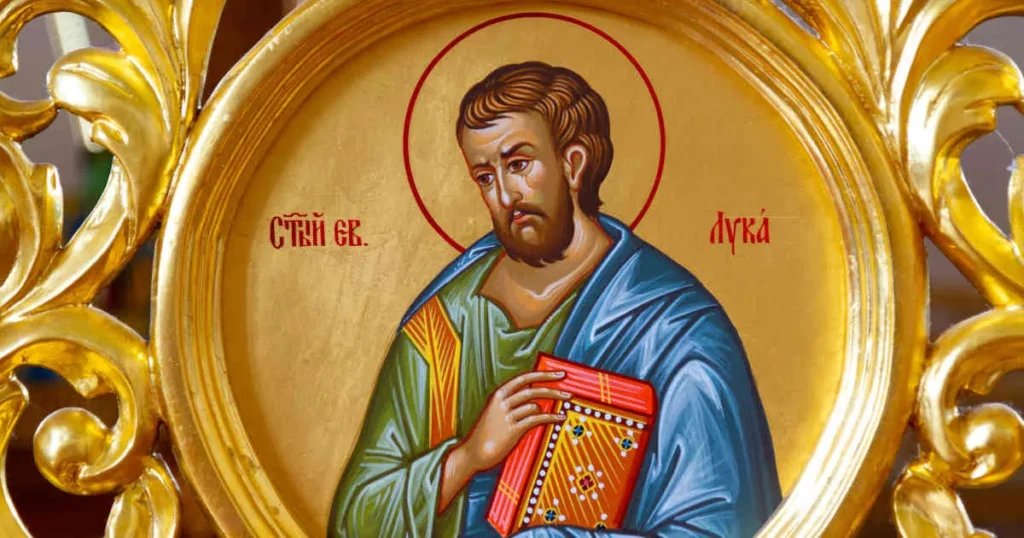
image: Icon of Saint Luke the Evangelist
located in the Convent of the Holy Trinity in Lomnica, Serbia