
Toward the end of the of the Hellenistic Age (336-146 BC), the residents of the Greco-Roman world began searching for a new religion. They wanted one that encouraged a personal relationship with a deity and one that affirmed equality for its members. Both the Jewish and the Isis religions were popular in the Roman Empire because they affirmed some of these qualities. This article will explore both religions because they influenced the rise of Christianity and offer a new understanding of Mary’s role in the Church.
The Jewish Community Awaits the Coming of the Messiah
Both the Old Testament and the Greco-Roman world influenced Christianity. Palestine was predominately Jewish within the first century, but it had a strong Hellenistic influence especially in Galilee.1
The Jewish Community longed for the coming of the Messiah. They expected a ruler like David, who was the great king of Israel. He conquered Jerusalem and set the standards for all kings (Genesis 14:18). David ruled by justice, wisdom, integrity, courage and compassion. He was a faithful servant of YHWH, obedient to the Jewish law and an ideal king.
The Old Testament contains over 300 prophecies relative to the Messiah’s coming. The prophet Isaiah reveals many of them. Isaiah taught: “The Lord Himself will give you a sign. The virgin shall be with child, bear a son and shall name him Immanuel” (Isaiah 7:14).
The predictions proposed by Isaiah were concerned with the preservation of Judah, and the fulfillment of God’s earlier promise to David to ensure his kingdom would last forever (2 Samuel 7:16). However, Judaism changed with the destruction of the temple in 70 CE. Faith became separate from the people, and this led to the separation of Judaism and Christianity. Christians taught the promise made to the Israelites (Isaiah 9:5-7) was fulfilled through Mary (Luke 1:32-33).2
Mary: The Mother of Jesus
The Gospel of Luke links the Old Testament expectations of the Messiah with the Christian tradition. According to Luke, God sent an angel to a virgin betrothed to a man named Joseph of the House of David and the virgin’s name was Mary (Luke 1:26-8). Coming to her, the angel said, “Hail favored one! The Lord is with you. But she was greatly troubled…. Then the angel said to her, “Do not be afraid, Mary, for you have found favor with God. Behold you will conceive and bear a son, and you shall name him Jesus. He will be called the Son of the Most High and the Lord God will give him the throne of David. He will rule over the House of Jacob forever” (Luke 1:26-34).
Mary responded: “Be it done according to your will.” She continued, “Behold, I am the handmaid of the Lord. May it be done according to your word” (Luke 1:38). The angel departed and Mary set out to visit her cousin who was expecting a son in her old age (Luke 1:37). Like David, Mary was a faithful servant of YHWH. Luke’s Gospel integrates the Jewish expectation of the Messiah with the Greco-Roman tradition of Isis.
Isis: The Mother Goddess of Egypt and the Greco-Roman World
Isis was worshipped in Egypt as Queen alongside of brother and husband, Osiris. As Queen, Isis sought justice for the poor and equality for all, while her husband was known as the god of the living and dead. Like Isis, he promoted peace and and harmony within his kingdom.
However, Osiris’ brother, Seth, was envious of him and killed him. Seth cut Osiris into pieces, put him into a chest and threw the container into the Nile River. The chest washed ashore and was found by Isis. She temporarily brought Osiris back to life, and she became known as the only deity capable of resurrection.3
Later, she became pregnant and bore a son, Horus. Her son avenged his father’s death by killing his uncle. Horus became known as the First Pharaoh of Egypt, while his mother was granted the title, the Divine Mother of Pharaoh.
A Comparison of Isis and Mary
Isis was known for her wisdom, courage and compassion. Isis’ popularity was due to her attributes as a healing deity, ideal mother, all powerful and for her association with both life and death. As a result, numerous statues, temples and sanctuaries were erected to honor her.4 Isis was hailed as the Great Virgin and Mother Goddess before Christianity.
Because of Isis’ great popularity within the Roman Empire, questions have recently been raised as to whether or not Mary is a second Isis or did the early Christians just attribute some of Isis’ qualities to Mary?5 By comparing the qualities of both women, one can observe their differences and similarities. Both women had hymns written about them which illustrate some of the differences between the two religions.
Isis Hymn6
I am the first and the last….
I am the one alone who exists.
I am the voice sounding
throughout the world.
The Song of Mary7
My soul proclaims the greatness of the Lord
The Mighty has done great things for me.
For He has looked upon His handmaid’s
lowliness and now calls me blessed.
I am power….
He has thrown down rulers from their thrones, but lifted up the lowly.
Listen to Me….
The hungry He has filled with good things, sent the rich away and fulfilled the promise made to Israel to send a Messiah.
The Hymns clearly identify significant differences. Isis is the goddess with major powers. She is omnipresent, benevolent, merciful, exclusive but not monotheistic.8 However, Mary describes herself as a servant of her God and savior. On the other hand, both Isis and Mary were mothers who protected their sons against evil kings and were depicted in sculptures lovingly holding their sons while nursing them.
Isis and Mary were worshipped together at the healing sanctuaries in Thessalonica and Philippi because the people believed healing powers resided in a mother’s milk.9 Both women sought justice for the poor and equality for all. The early Christians seem to adopt Isis’ qualities as a woman and mother for the Christian Community (Gal.3:28). They later attributed these qualities to Mary.
Who was Mary in the Post-Gospel Era?
The Gospels describe Mary as the Mother of Jesus (Lk 1:26-36; Mt1:18). She affirms Jesus as the anointed one, savior and the fulfillment of God’s redemptive plan. On the other hand, Jesus referred to Mary as woman not mother until the crucifixion (Jn. 19:26). Both Paul (Gal 4:14) and John (Rev 12:1; 12:5-6) describe Mary as a woman who symbolizes all women. This theme is reflected in the Book of Revelations.
The Book of Revelations is addressed to the seven Asian Churches. Each letter is presented as a heavenly discourse of what God will soon do for the suffering people. The text integrates some Old Testament expectations and the author’s glimpse of a heavenly life with God (Rev 12:4).
In Chapter 12, the author describes a woman clothed with the sun, the moon under her feet and on her head twelve stars (Rev 12:1).10 She was with child, but a dragon appeared ready to devour the child (Rev 12:4). The child was “caught up to God” meaning he changed locations from an earthly life to one in heaven. While the woman escaped to the desert where God prepared a place for her (Rev. 12:5-6).
The author of Revelations uses symbolism that the early Christians would recognize. The twelve stars represented the 12 tribes of Israel while the dragon represented evil (Ps 74:13-4). The woman’s escape was seen as a place of divine protection to await Christ’s second coming (Ex 19:4; Is 40:31). Both the child and the woman remind the community that we all await Christ’s second coming when we will be relocated with God forever. The woman in chapter 12 may refer to Mary who crushed the Isis Cult or the Church. Some theologians suggest a combination of both traditions. Isis’ status as a mother and her feminine qualities are attributed to both Mary and the Church.11
Mary: The Mother of the Church
Mary has been an integral part of the Christian tradition. She was very popular within the first millennium. The Eastern Church used the title, Theotokos, meaning Christ bearer within their liturgies. On the other hand, the Western Church translated Theotokos to mean Mother of God. The Council of Ephesus (431 CE) defined Mary’s title as Christ bearer not God bearer.12
Later, the Church taught Mary’s body was assumed into heaven like Elijah (2 Kgs. 2:1-18), and she was free from original sin as the Mother of God. The Second Vatican Council raised some questions relative to these traditions.
The Vatican ll bishops were able to compromise on two theological documents. The first one was Christocentric which is Mary’s relationship to her son and secondly, her role in salvation history.13 The Council Fathers incorporated the doctrine on Mary into the Constitution on the Church.14
Mary’s yes to God to be the Mother of Jesus (Lk 1:38) established her as the New Eve and the mother of the New Adam who brings new life (LG, chap. 2, par. 56). Together, Mary and Jesus worked to bring about peace and joy to all people. Mary encouraged her son to perform a miracle at Cana for a wedding couple (LG, chap. 2, par. 58). Later, she prayed with his disciples for the gift of the Holy Spirit (Acts 1:14; LG, chap.2, par. 59).
The Council Fathers once again affirmed Mary’s Immaculate Conception and Assumption into heaven (LG, chap.2, par. 59). These documents bring Mary closer to the human experience, but also give us a hope and direction for the future. Most religions describe God in male terms, whereas Christians describe God through male and female attributes. Isaiah claims God is father, mother and potter. Therefore, God is all three (Is. 45:9-11).15
The Council Fathers rejected identifying any one title for Mary. Instead, they focused on her virtues particularly in relationship to the Incarnation (LG, chap.2, par.65).16 Mary is loving, compassionate and attentive to the poor and sufferings of society. She is the protype for all women because she is a figure of strength and power. Thus, they see her as the feminine side of God.17
Summary and Conclusion
Christians believed God fulfilled the covenant made to the Israelites and established a new covenant on the hearts of the people by the Holy Spirit. God said, “I will be their God, and they will be my people” (Jer. 31:31-4).18
The early Christians advocated a need to balance the feminine and masculine qualities within the church (Gal. 3:28). Thus, Jesus’ disciples including Mary gathered to await the coming of the Holy Spirit. Feminine deities were prominent from 2000 BC to 500 CE. Their presence changed religions.19 Mary brought this dimension to the early Church.
Pope Francis echoes a similar need today for both male and female voices within the Church. He told members of the planning commission that at the next International Council of Cardinals, “We will have a reflection on the feminine dimension of the Church.”20
The feminine quality that the Church needs is the wisdom passed onto the next generation. To be feminine is to guide others through trials and celebrations. This is what Mary and women can do for the Church today. This is Pope Francis’ vision and one many share!

Endnotes
1Raymond Brown, An Introduction to the New Testament (New York: Doubleday, 1997), 74.
2Kenneth Boa, Talking Through the Old Testament (Wheaton, IL: Tyndale House Publishers, 1980), 61-62.
3Hazel Butler, “The Cult of Isis and Early Christianity.” See https://hilo.hawaii.edu/campuscenter/hohonu/volumes/documents/Vol05x19. Accessed on May 19, 2024.
4Ilana Herzig, “Worshipping the Forbidden Goddess,” Archaeology (November/December, 2023): 25-29. With the rise of Christianity between the fourth and sixth centuries, Emperors like Constantine (324-337) and Justinian (527-565) tried to diminish paganism. Constantine converted temples into churches, and Justinian evoked the pagan instructors’ licenses to teach. In spite of the official attempts to ban paganism, it remained widespread in parts of the empire. In fact, a statue of Isis was recently discovered dating to the 6th century. This discovery indicates Isis was still worshipped alongside Christianity.
See Jarret A. Lobell, “Top 10 Discoveries of 2023,” Archaeology (January/February,2024): 22-28.
5Jessica Jewett, “Did Isis Become the Virgin Mary?” See https://jessicajewettonline.com/did-isis-become-the-virgin-mary…. Accessed on May 19, 2024.
6Richard Smith, ed., The Nag Hammadi Library (New York: Harper San Francisco, 1978), “The Thunder: The Perfect Mind,” by Douglas M. Parrott, ed., 297-303. “The Thunder: The Perfect Mind” document was discovered among the Nag Hammadi collection in 1945. In the introduction to the document, George W. MacRae says the text does not contain any distinct Christian, Jewish or Gnostic allusions, but the self- proclamations are similar to Isis (296). Both Smith and Parrott believe the voice is that of Isis. However, Lesley Hazleton suggests it could be Mary. See Lesley Hazleton, Mary (New York: Bloomsbury Publisher, 2004), 205.
7The Song of Mary (Lk. 1:46-57) is similar to Hannah’s Song (1 Sam. 1:11). Mary Aquin O’Neil suggests the Magnificat emphasizes Mary’s prophetic voice. See Mary Aquin O’Neil, Original Grace (Eugene, Oregon: Cascade Books, 2023), 26 and 29.
8Henry C. Boren, The Ancient World (Englewood Cliffs, NJ: Prentice Hall, 1986), 220.
9Valerie A. Abrahamsen, “Mary, Isis and the Goddess of the Via Egnatia.” See https:// www. biblicalarchaelogy.org/daily/biblical-sites-places/Mary-Isis-and the goddess-of-the via-egnatia. Accessed on May 19, 2024.
10Both Mary and Isis shared the title, Star of the Sea. See Michael Jordan, Encyclopedia of the Gods (New York: Facts on File Inc., 1993), 118.
11Carol P. Christ and others, eds., Womanspirit Rising: A Feminist Reader in Religion (New York: Harper San Francisco, 1992), “Feminist Spirituality, Christian Identity and Catholic Vision,” by Elisabeth Schüssler Fiorenza,136-49.
12Jaroslav Pelikan, Mary Through the Centuries (Grand Rapids, MI: Yale University, 1996), 56-57.
13Richard R. Gaillardetz, The Church in the Making (New York: Mahwah, NJ, 2006), 57.
14Walter Abbott, ed., The Documents of Vatican II (New York, Guild Press, 1966). The document will be referred to as LG (Lumen Gentium).
15Carol A. Newsom and others, eds. The Women’s Bible Commentary (USA: Westminster/John Knox Press, 1992), “Isaiah,” by Susan Ackerman, 167.
16Gaillardetz, The Church, 57-58.
17Carol Frances Jegen, ed., Mary According to Women (Kansas City, Missouri: Leaven Press, 1985), “Mary in the Mystery of the Church,” by Anne Carr. She quotes Elisabeth Schüssler Fiorenza as saying Mary reflects the feminine side of God and the Church, 9.
18Denise Lardner Carmody, Biblical Women (New York: Crossroads, 1989), 82.
19Carol P. Christ, and others, eds., Womanspirit Rising: A Feminist Reader in Religion (New York: Harper Collins Publishers, 1992), “When God Was A Woman,” by Merlin Stone, 120-31.
20Vatican News, December 4, 2023. See https: www.vaticannews-va>news. Accessed on May 19, 2024.
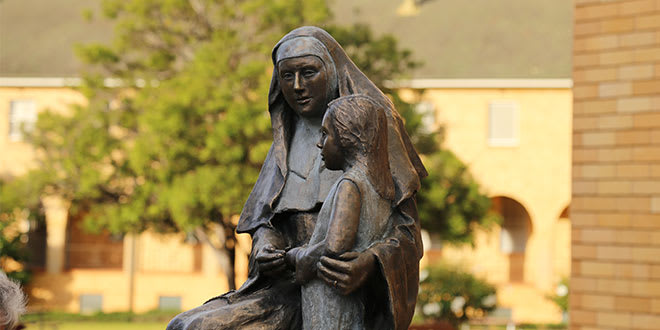
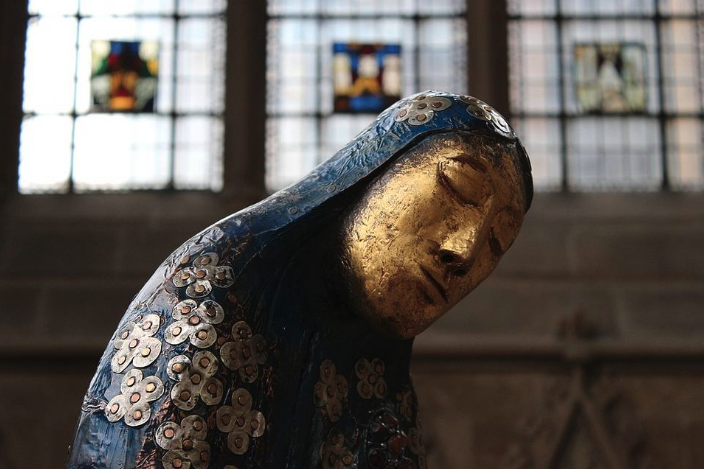
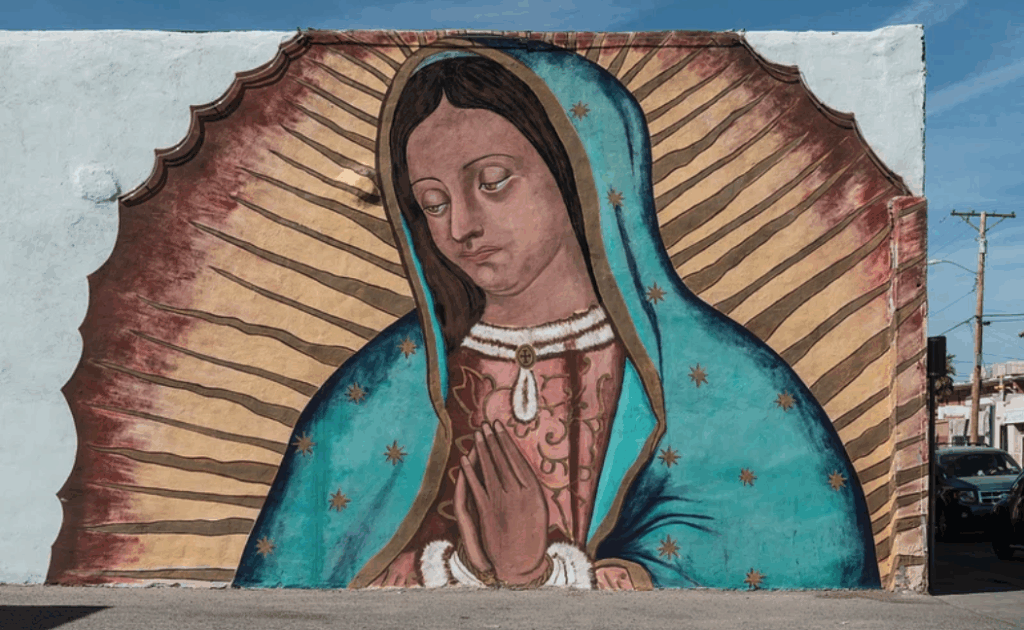
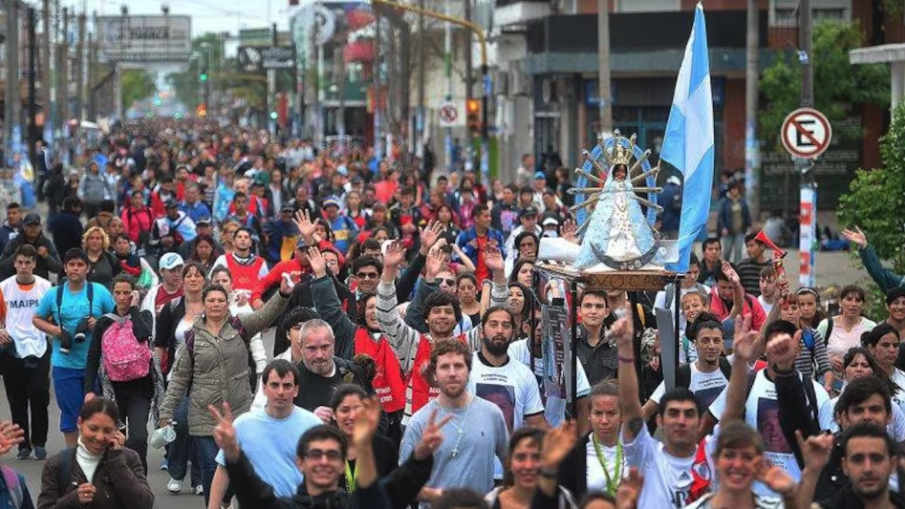
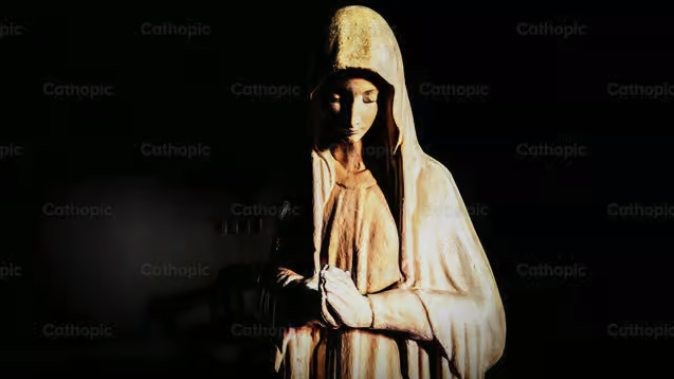
image: photo of a statue of mary by
@gonzalesroman on Cathopic