
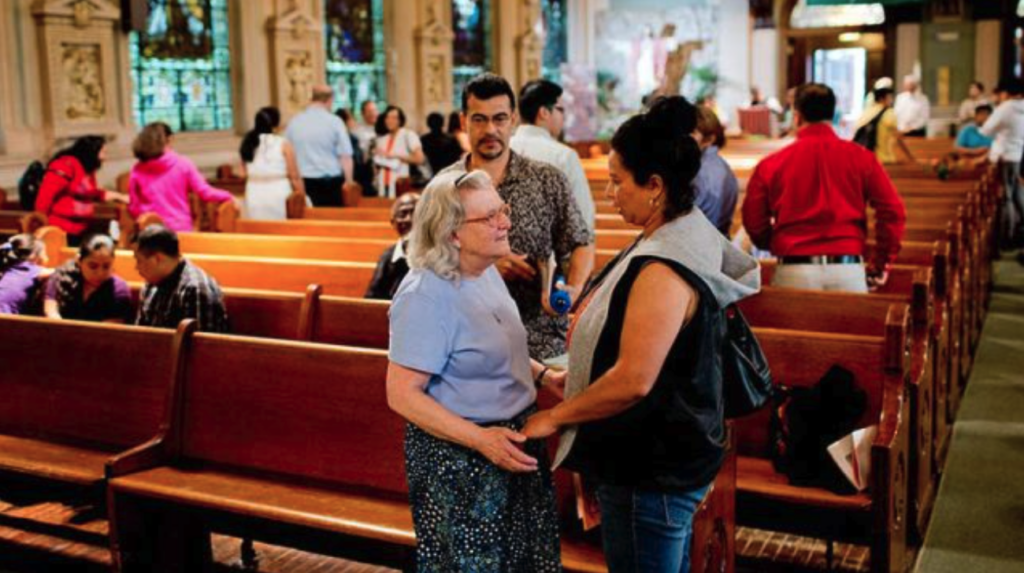
The Sisters of Mercy have responded to God’s calling in many ways throughout history. More recently, we have seen a change in the ministerial efforts of Sisters of Mercy with a growing number of sisters serving the Church in parish or diocesan roles. A quick scan of a listing of our sisters’ ministries revealed over fifty sisters whose principal ministry is in these venues. In order to learn more about their work I sent a brief questionnaire to each one and received twenty-nine responses. The following are some observations about their ministry. (Note: This does not qualify as a scientific research effort—just as a conversation with them.)[1]
Parish Ministry
We can begin with sisters whose principal ministry is located in a parish. Typical responsibilities include the range of the Works of Mercy: visiting the sick, comforting the bereaved, instructing the ignorant, feeding the hungry…. Sisters lead faith formation programs at every level, e.g., preparation for First Communion, Confirmation, or Marriage. They lead the Rite of Christian Initiation for Adults planning to enter the Church. They coordinate events of every kind, e.g., prayer breakfasts, weekend retreats, funerals, Advent and Lenten services. They are liturgists and musicians. For example, Sister Larretta Rivera-Williams, RSM, plays the guitar and percussion instruments, sings, and choreographs liturgical dances.
Sisters work with youth groups and with senior citizens, for example, helping to organize outreach to those in need. Some are designated parish nurses, visiting the homebound, and others are Pastoral Administrators or Pastoral Associates. And in every case, when one is part of a pastoral team, there are bound to be “other duties as assigned.” Sister Catherine Pfleger, RSM, reported, “I did everything except celebrating Mass and hearing confessions!”
Sister Mary Ann Clarahan, RSM, worked in parish ministry in Rome as well as in several eastern states of the United States. When asked to compare her experience in Rome with that in the U.S., she said she ministered at Santa Suzanna’s, then the parish for U.S. Americans in Rome.[2] Because many of the parishioners were religious (Catholic sisters and brothers) studying in Rome or business leaders of American or international companies, they tended to be somewhat transient. At the same time, they brought their organizational skills to parish activities. Also, as in other Italian parishes, there were almost no night meetings.
Diocesan Service
Moving on to sisters whose principal ministry is diocesan-focused, we find an array of responsibilities, e.g., archivists, canon lawyers, and delegates to religious, i.e., liaisons between religious communities and the bishop of the diocese within which they live. Sister Connie Derby, RSM,’s twenty-nine years as the Director of Archives for the Diocese of Rochester contributed to the preservation of the history of the vibrant life of the Church within the diocese at the parish and diocesan levels. (She also served in the Diocesan Office for Evangelization and Catechesis and as an accounting assistant!) Sister Victoria Vondenberger, RSM, [JV1] recently retired from thirty-five years as a canonist for the Archdiocese of Cincinnati.[3] Sister Eleanor McCann, RSM, reported that when she served in the Office of Worship in the Diocese of Trenton, New Jersey, she was responsible for implementing the Rite of Christian Initiation throughout the four-county area of the diocese, as well as supporting the Director of the Office of Worship in areas such as helping to implement the New Roman Missal and supporting pastors as they built and renovated their parish churches.
In her ministry in the Diocese of Oklahoma City, Sister Diane Koorie, RSM, is responsible for the formation of the laity for ministry as well as for various experiences of formation for those in ministry, e.g., a monthly in-service for parish office personnel. She cited the four pillars of formation that the diocese strives to offer: human, spiritual, intellectual, and pastoral. In her role as liaison for the bishop to all of those in consecrated life in the diocese, Sister Margaret Downing, RSM visited individuals and ministries and gathered those in consecrated life for meetings with the bishop and among themselves. She was also involved in preparing those who wanted to become consecrated virgins. In her ministry for the Archdiocese of Louisville, Sister Justina Heneghan, RSM, was involved in archdiocesan planning, including designing and facilitating parish mergers. She remarks, “I impacted new parish formation and transitions positively (although painfully) to their new reality.”
Some sisters who were primarily assigned to parishes also had some diocesan responsibilities. For example, Sister Connie Howe who was a Pastoral Associate in a parish in the Archdiocese of Dubuque, also served as a tribunal advocate and as a member of three diocesan advisory boards.
International and National Service
Going beyond diocesan boundaries, we have at least two sisters whose Church service is international or national. Sister Angela Perez, RSM, had been serving as the Archdiocesan Delegate for Women Religious for about seven years when Pope Francis appointed her a voting delegate to the Synod of Bishops in 2023. She participated in the Synodal Assembly in October 2023, but was unable to attend the October 2024 session, due to health reasons. More recently her archbishop asked her to attend the Jubilee for Synodal Teams and Participatory Bodies as a member of the Synodal Team of the Archdiocese, held at the Vatican in October 2025. She also continues in her role as Delegate for Women Religious, a role in which she has introduced the synodal method. She has also been invited by previous archbishops—and now by the current archbishop—to participate in shared responsibility and decision-making. Sister Angela reflects that her past years of community leadership are part of the wisdom she brings to the table.
Sister Sharon Euart, RSM, began her Church service as Director of Research and Planning for the Archdiocese of Baltimore. At the urging of the archbishop and with his support she began her studies in canon law, ultimately leading to her doctorate. Next she served at the United States Catholic Conference[4] for thirteen years, most of that time as an Associate General Secretary. In that role she oversaw ten departments such as doctrine and pastoral practices, ecumenism, priestly formation, priestly life and mission, the diaconate, consecrated life, the laity (including family life, women, and youth), canonical affairs, and worship! She also planned the agendas for the bishops’ assemblies and attended all of their assemblies and retreats. Reflecting on her experience with the bishops’ conference, Sister Sharon says, “It gave me insight into the breadth of the Church’s internal life that I could never have gained otherwise, and it has shaped every ministry and service I’ve undertaken since.” For the past twelve years she has served as the Executive Director of the Resource Center for Religious Institutes (RCRI).
Qualifications and Gifts for Service
Acknowledging the significant role our Mercy sisters play in these Church ministries, we should also call out the qualifications they bring to their service. First of all is their vocation to Mercy. Experiences in congregational leadership and vocation ministry were mentioned by survey respondents, as well as previous ministries such as nursing and teaching at all levels. Some mentioned their experience in group management and organizational development. Sister Kim Lajoie, RSM, mentioned “belonging to a loving supportive local community of at least four sisters over the years.” Sister Mary Oladimeji, RSM, noted that her graduate studies focused on nonviolence, one of Mercy’s Critical Concerns.[5] Sister Marietta Bradley, RSM, said her presence as a Sister of Mercy “seems to be comparable to a beacon of hope for those who need it.” Several mentioned that the opportunity to “be Mercy’ is what sustained them in Church ministry.
Sister Mary Anne Poeschl, RSM, mentioned that she is the oldest of four siblings “so I am used to taking responsibility and doing what needs to be done or getting someone more qualified to get it done!”
Mercy sisters have an impressive array of academic qualifications: doctoral and master’s degrees and licentiates in many relevant fields: canon law, theology, sacred scripture, religious studies, liturgy and sacraments, nursing and public health, counseling, and education. To that can be added certifications as spiritual directors and a bilingual facility. Truly a gift to the church!
Previous ministry experiences have also prepared sisters for roles in parish or diocesan ministry. Sister Guia Jimenez, RSM, who is from the Philippines and transferred to Mercy from an Italian religious community, gave talks and retreats in the Philippines and worked in several other countries including Indonesia, Ecuador, Italy, and the United States prior to joining the Sisters of Mercy of the Americas. She reflects that, in addition to her familiarity with all of these languages, she carries the previous ministry experiences in her current parish ministry.
Sister Martha Meyer, RSM, shared that her previous seventeen years of experience ministering to people in need in Appalachia was a valuable background. Sister Mary Burke, RSM’s, wide experience in practicing and teaching nursing enabled her to develop a program for students in three diocesan schools to prepare to meet the challenges of drugs and alcohol. Sister Bernadette Hart, RSM’s, previous thirty-six years of teaching made her a natural to serve as the parish Director of Religious Education, serving teachers and staff in eighteen elementary classes. She was also the Principal of the Sunday Religious Education Classes and led the preparation for First Communion, which entailed working directly with parents.
Significance of Sisters’ Contributions
Beyond identifying the focus of their Church ministries and the qualifications they bring to it, are questions of significance and meaning.
Each sister was asked if she believed her contribution has [or had] a significant impact on the local Church. Responses were unanimous in the affirmative. When asked to give an example of her impact, Sister Catherine Pfleger, RSM, noted, “During the thirty plus years under six pastors, there were a few very difficult years. I was told that I held the parish together.” Sister Sheila Stevenson, RSM, had a similar experience with a new parish: “I believe that my greatest impact has been on the people of the parish and the wonderful staff in bringing together a foundering newly configured parish into a cohesive, vibrant parish after five years of formally being together as one in name and corporate structure. The bishop was also very grateful and regularly acknowledges in the public arena my leadership of the parish.”
Sister Mary Anne Clarahan, RSM, observed that lay people often seem more appreciate of sisters’ contributions than do the clergy who sometimes seem to take it for granted.
Sister Donna D’Alia, RSM, gave a practical example of an activity that binds people together. “Our Confirmation service project pairs up young people with a homebound or sick parishioner or those in nursing facilities. They become prayer partners for one another and communicate with each other through cards and notes. I cannot begin to tell you how much positive feedback I get from those parishioners and those who deliver their cards.”
Appreciation of Women’s Contributions
Responses were more varied when it came to the following question: “Over your years in Church ministry, how do you feel about the appreciation of women’s contributions?” Sixteen respondents felt the appreciation had increased; eight felt it had remained about the same; four said it had lessened; and one skipped the question. Most seemed to agree with the observation of Sister Emily Morgan, RSM, (who worked in fourteen parishes in two clusters, eight in southern Texas and six in northern Mississippi}: “It depends a lot on who’s the current pastor or bishop.” Several agreed with Sister Connie Derby, RSM’s, comment, “There is an appreciation for the role women religious have played. What needs to be expanded upon would be an appreciation for the role lay women have played or could play in the parish and diocesan church.” As Sister Margaret Downing, RSM, put it, she received great appreciation for her own work, “However, I don’t see much difference overall in the appreciation of [lay] women’s contributions. Women are not sought out for church ministry, and those who are doing it tend to be overworked and underpaid, if they are not volunteers.”
Closing Thoughts
As mentioned at the outset, this was not a scientific survey, but a kind of conversation with some of our Mercy sisters who work, or who have worked, in specific Church roles. In these few pages we could not begin to summarize all of the contributions of our sisters to Church life. As our Mercy Constitutions puts it:
Catherine McAuley founded the Institute to involve women as religious in the mission of the church in the world. (#1)
To this end we serve God’s people though ministries that further social, political, economic and spiritual well-being. (#4)
I think Catherine McAuley would be proud of the efforts our sisters have made, and are making, to engage in the Church’s mission in parishes and dioceses. We have shown our ability to adapt to new needs and circumstances and to help others do so as well.
[1] I apologize to any sisters in Church ministry whom I missed. Scouring over 1,700 names in our “mercysource” database was a daunting task. I tried to focus on sisters who had worked in Church ministry within the last five years.
[2] Santa Suzanna’s has since been replaced by San Patrizio’s as the U.S. American Parish.
[3] Sister Victoria describes her experiences and offers her observations in another article in this issue of The MAST Journal.
[4] The United States Conference of Catholic (USCC) merged with the National Conference of Catholic Bishops (NCCB) in 2001 to become the United States Conference of Catholic Bishops (USCCB) as it is still known today.
[5] The Sisters of Mercy focus on five core “Critical Concerns”: Earth, Immigration, Nonviolence, Racism, and Women; see https://sistersofmercy.org/mercy-for-justice/

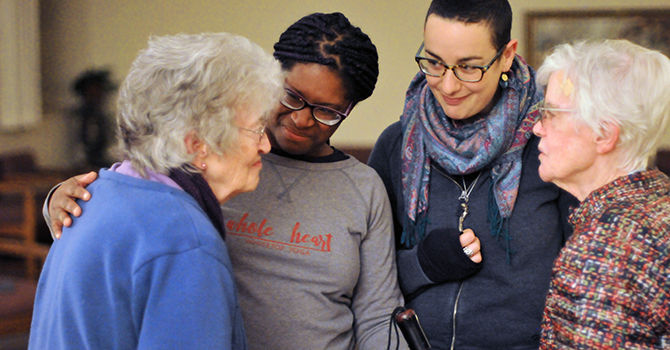
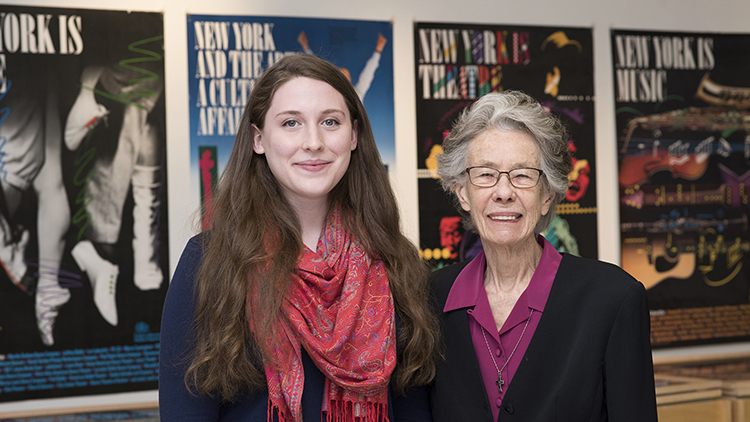
image: Patricia Pora, RSM, and a parishioner at Sacred Heart Church in Portland, Maine, talk after Mass
via Gabe Souza/Portland Press Herald