
Mercy Circle Community, Sisters of Mercy, Chicago, Illinois
Attendance: 20 Sisters, Associates, and Mercy Center Residents
Our Experience of Church
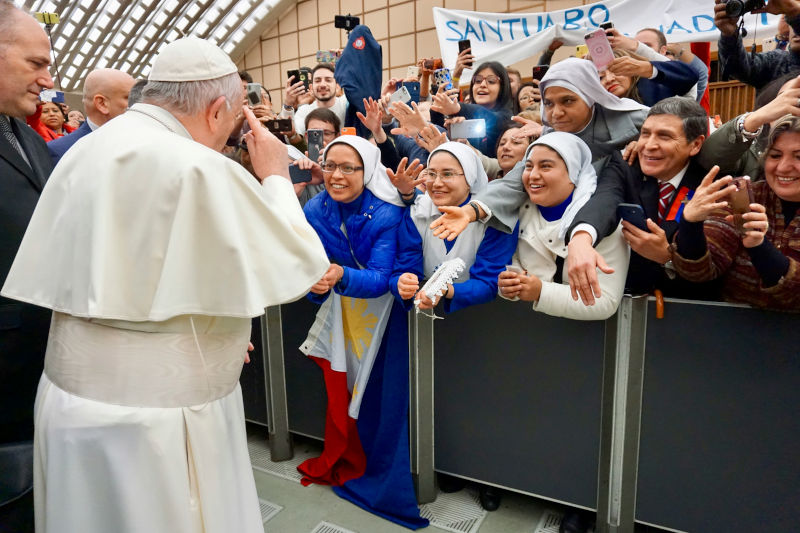
Pope Francis offers a new image of the papacy. He leads by example in so many ways – discarding so much of the elegant trappings of the position, visiting migrant camps, calling attention to and pushing for action on climate change. Asking for our prayers from the balcony at the Vatican right after he was elected – it signaled a new world, a person who saw himself like us.
Parishes are often a primary way that Catholics experience the Church and practice their faith. More and more, people choose their parishes rather than abide by parish boundaries. What attracts? There are various answers, but these come up with some frequency: good music, knowing others in the parish, being welcome to contribute to parish life, feeling at home, quality preaching.
The changing demographics of parishes are a mixed reality. Some parishioners feel a real loss as the comfort, the at-homeness of ethnic or fairly homogeneous parishes fades with changing neighborhoods or parish mergers. Other Catholics are searching for parishes that are ethnically and racially diverse, that give life to the notion of catholic/universal. How are changing parishes changing us? How are we changing our parishes?
Though this is not universal, it seems that bishops and believers are growing more distant from each other. As one participant said, “Bishops don’t represent us.” Priests who are in sync with their people often are not promoted or run afoul of ecclesiastical authority. The silencing of theologians – those who speak truth to power or explore the faith in the light of current science – does not bode well for the Church’s future. Science and theology need to work together. The power of money and the preponderance of bishops who have law degrees fosters a culture of rule-making, rule-enforcing. If that continues more people will drop out of the Church…and yet, there are bishops – and lay adult Catholics – who are very uneasy about not having rules by which to shape their lives and keep things in control.
There is also a growing climate of fear or hesitancy among Catholics (and Americans) about speaking honestly with one another. We fear offending the other; we fear violence and division; we struggle to be respectful yet honest in our diversity – something, it seems, that synodality is trying to help us address and overcome.
What kind of a Church do we want for our future? What do we need to DO as Catholics and Church members to bring a desired future Church into being? We can’t and ought not to simply sit in the pews. God the Spirit lives within us and calls us to action. It is essential to keep the focus on God and place our trust there. The Spirit is still in charge and will lead us faithfully if we stop trying to be God ourselves.
Evening Session : The Whip-Around
In a phrase, what did you hear this evening?
- a real love for the Church
- the notion of parishes changing and that it’s up to us to make that change
- a feeling of hope
- both a reaching out and a drawing in
- experience influences how each of us sees the Church
- open to everyone
- a longint65g for diversity and an openness to it
- a willingness to share at a deep level
- desire for significant change and a hope that we can make it
- everyone has some responsibility for the changes we desire
- listening and participating
- a plea for clear language
- understanding others with whom we don’t agree
- all are responsible to listen to/for the Spirit
- good will and hope – that we’re here and talking
Listening and Communion
Listening is the first step toward a felt sense of communion, but it requires an open mind and heart, without prejudice. All are invited to speak with courage and parrhesia, or bold and forthright speaking; that is, in freedom, truth and charity.
This following statement is printed in the workbook: In the Church and in society we are side by side on the same road. Does this ring true for you? Who are those living in the margins where you are living? Do you feel as if you are living in the margin?
What happens that makes you feel marginal in your experience of faith community? What can we do for those on the margins and bring those more to the center? How does what we hear from each other enhance, inform, or challenge how we journey together?
Morning Session
- The call to communion must be invitational. Answers need to be uncovered as to why people no longer participate. Then, listen without being defensive.
- Church ought to be a place where believers are validated; a bold Christianity without extremism; soul-fed. Learn to authentically appreciate the diversity of styles that express our Christian spirituality; Jesus marginalized no one.
- Again, this is a time to return to the sources, as the call of Vatican II, and re-embrace the role women played in the early church (the call for restoration of women to the deaconate arose again and again). This time in church life is akin to the T.S. Eliot poem: “We shall not cease from exploration and the end of all our exploring will be to arrive where we started and know the place for the first time.”
- A church connected to the people; rituals that engage; source of spiritual nurture; place of compassion; call to gospel life—all this can be part of healing the opposition and polarization we find today, marring and fracturing church life.
- How can we avoid the insularity of wherever one lives or worships so that true ecclesial community can flourish? There are always those on the margins of wherever one is living, and we need to know who they are, meet them there and accompany them to a place of belonging.
- Must challenge each other with what is left if YOU walk away. Highlight those faith communities (Old St. Pat’s) where all are welcome.
Afternoon Session
- Assessment that we are not side-by-side on the same road; The Council of Trent emerges to hold a grip on the deeper renewal begun with Vatican II.
- The church (instructional leadership and membership) has allowed itself to become highly polarized and politicized and thus cannot be a voice for the breaking through of the Spirit in our times when realities are so different from 100 years ago: emergence of liberation movements; global migration and immigrants; rights and roles of women; new continuum of experiencing human sexuality (including homosexual and transgender realities); new understandings arising from the sciences; ecological crises; loss of connection with younger folks abandoning organized religion.
- How can we walk side-by-side when too many (noted above) are excluded from the table and the dominant conversation; there are too many road signs that say STOP or EXIT, and we lose the company of those walking away because they are excluded from full belonging. Too many taking the off ramp because there is no way for them to fully participate without denying their reality.
- Lack of leadership within the institutional church; growing awareness among many that the Bishops and Cardinals themselves are failing to support the Pope’s efforts and vision or a more alert and inclusive universal church. Institutional leadership is still too devoted to preservation of status quo and less engaged with the Spirit and reading the signs of these times.
- Synodality entails receptivity to change, formation and ongoing learning. Above all the Church works for justice, peace and respect for all human life. Celebrating Eucharistic Liturgy is the most visible aspect of our religion. The church’s mission also includes service, evangelization, healing, and teaching. Does our faith steer us when making decisions and weighing values? Does it bring consolation? Does it challenge you to sacrifice?
- We would like the most visible sign of the church to be the church that works for justice, peace and respect for all human life rooted in the values of the Hebrew and Christian scriptures. Therein, is a faith that steers the church while a clerical-centered church exists to maintain itself. Too many of the obstacles to a vital church are lodged in unaddressed and unhealed clericalism.
- It is faith that brings consolation and kinship and points us out to the world.
- Having a church with a strong conservative, strong progressive and strong middle center could provide for the possibility of having true conversation and communion from which the whole could grow. A truly pastoral church where all are welcome to find and take a place could indeed be a visible sign of God’s kingdom in the making.
- Radical change—metanoia—is necessary in order to get beyond institutions and structures. Sacraments are integrated and seen as living values for living people: provide and provoke a sense of faith community; facilitate forgiveness; offer consolation; make bread the body of Christ—this we do all together. Sacraments are not something we get, but rather, what we live.
Another Afternoon Session
- Is Eucharist really the most visible aspect of our religion, especially after the pandemic? Or is it a shared faith that brings both consolation and challenge?
- Church and faith are very different experiences. Church as pilgrim people on a shared journey is not as strong experience for many today and is overwhelmed by doctrinal lines in the sand; the still lingering “no salvation outside the church.” We observe more law-focus than spirit-driven.
- Our vision of the church is a wider church able to embrace those of other religious traditions in order to continue the impetus of Vatican II and its reverence for ecumenical and interreligious dialogue. There seems to be a large gap between the Expectations of Vatican II and church life today.
- It seems as if many of the “reforms” of Vatican II are sources of discontent today. The appreciation for the sciences, liturgy as work of the people, ecumenism and interfaith outreach appears to have dwindled from the energy it once had following Vatican II. In short, Vatican II has yet to come to fulfillment. Are we willing to be open to the complexities of an evolving historical, cultural and religious reality?
- Polarization in church, society; country and world find us in a place of division, crises, and suffering. What can we learn through this suffering? Can we open ourselves to a church that is a safety net for those needing a spiritual belonging, such as the LGBTQ community? How can you evangelize when all are NOT welcome?
- More lay participation, a church less defined as “institution” and more “people of God.” More meaningful participation in liturgy may indeed be part of a better roadmap for the future. However, without addressing an overly hierarchical and clerical church there will continue to be more stop signs than open roads.
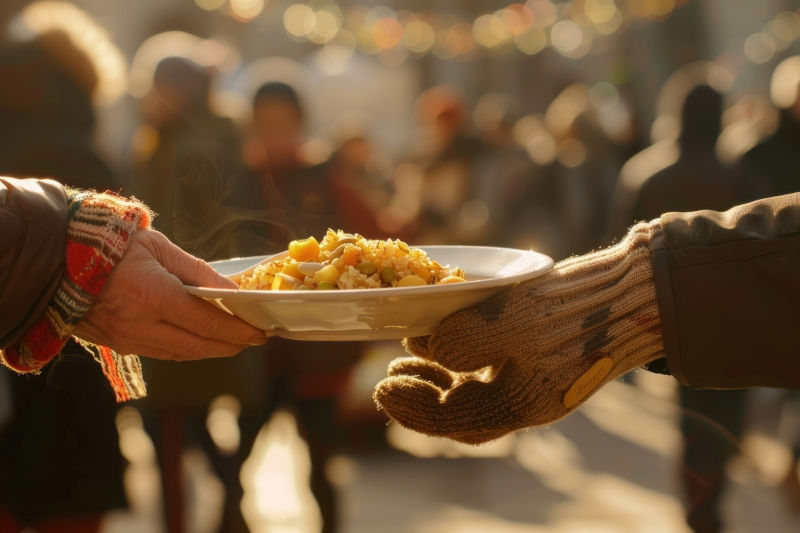
- Human need continues to challenge us to sacrifice as seen in food pantries, Catholic Charities, Network, and so many more venues reveal the continuing willingness of the faithful to give and serve the least among us. Social action for justice remains a strong Catholic ethos.