
Growing up in a very small town, my first somewhat official involvement with the clergy and the structure of the Church was when I was in eighth grade and was asked to become a parish organist at St. Mary’s Church in Piqua, Ohio. Before the changes of Vatican II, beginning when I was a high school freshman, I played at multiple Masses a day. I would usually play the organ for the 6:30 a.m. Mass and then spend time at the rectory next to the church before playing the 8 a.m. grade school Mass after which I’d go finally to my class homeroom. Because I was there each morning, our pastor Father (later Monsignor) Robert Von Kaenel eventually showed me how to process requests for baptismal certificates which I did regularly, stamping his signature and impressing the seal of the parish.
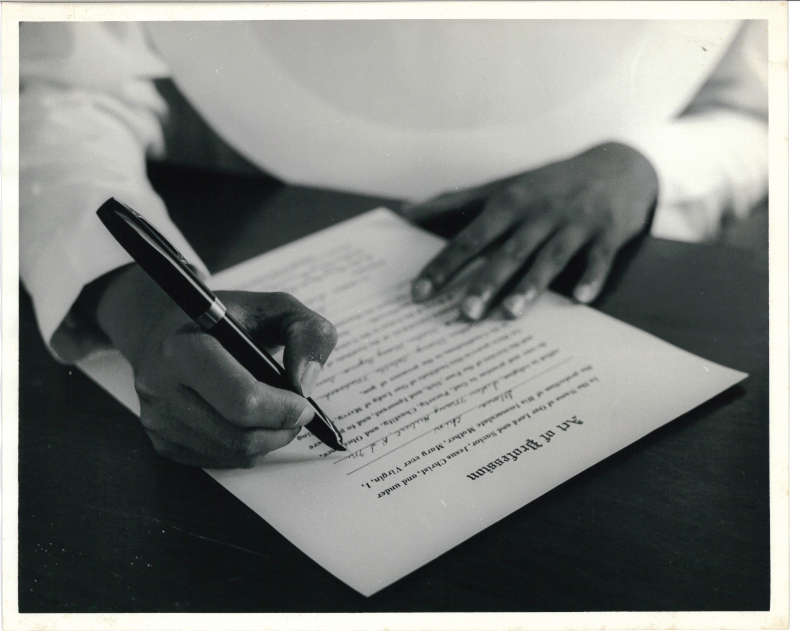
Before scheduling my senior year classes, I was told that I could complete high school in three years partly because I was a good student in a small high school without advanced placement classes. I had in mind that I might want to become a Sister of Mercy. But I struggled to behave in study halls, so my faculty advisors signed me up for additional classes. By the end of junior year, I needed one credit in civics to graduate which I could do in a summer course. My advisor said if I were still serious about entering the convent, we could see if Our Lady of Cincinnati College –where postulants of the Sisters of Mercy attended classes – would accept me with the credits I had. I knew my pastor “Father Von” would prefer that I continue being his early morning organist, so I wrote a letter to him, marked “baptismal certificate” on the envelope, and put it into the parish inbox from which I took such requests.
After I found out that I had been accepted to the Sisters of Mercy, I told my pastor who said, “But you can’t have that without your bap… you didn’t!” I explained what I did, and he laughingly said he would warn the Sisters of Mercy about me, but they already knew me from being my teachers.
A second experience of the clerical structure and hierarchy of the Church came when I was permitted, as a novice of the Sisters of Mercy, to attend a one-day workshop by musician Lucien Deiss, CSSp, for pastors and parish organists at the Cincinnati cathedral. It happened that my pastor was now at the cathedral. I knew I had only 20 minutes before I was to be picked up by a driver and returned to the novitiate. I quickly asked then Bishop Daniel Edward Pilarczyk if I could see “Father Von” and that I had little time. The bishop ran me through a sea of white in the undercroft of the building, moving past so many priests and their liturgical white albs. He went up to my pastor and said “Monsignor, this young Sister is asking for ‘Father Von.’” He turned around and said, “Oh, hell, she won’t call me ‘Monsignor’ unless I call her ‘Sister,’ and I’m not about to do that!” We had a good quick visit while he walked me out to meet the driver waiting for me.
Many years later, after I had completed twenty years of high school teaching and administration, the Cincinnati province of the Sisters of Mercy sent out a questionnaire asking what we saw ourselves doing in the next ten years to help them plan for corporate commitments. Curiously, I noticed that canon law was listed twice as I remember: once under the category “working for justice” and again under “Church ministry.” Nonetheless, I checkmarked the boxes for my usual interests of high school teacher or administrator, retreat work for which I had training, and running a switchboard which I enjoyed doing at the provincialate – the Sisters of Mercy’s administrative center – down the street from our juniorate where those of us preparing for final vows lived while attending college. I did not expect to be assigned to that which would have provided so much glorious time to read!
Even though I never checkmarked those boxes for canon law, I found that while I prayed in the mornings, the words “canon law” seemed to always blink in the background as if in neon lights. I called Gretchen, a Sister of Mercy from Toledo who was a member of the Provincial Council, to ask if they had listed “canon law” twice because the leadership team of the Sisters of Mercy really wanted someone for that ministry. She checked and came back saying it was simply a typo, and she laughingly said she felt sure I would see as the Holy Spirit.
I did.
I asked my spiritual director Henry Birkenhauer, SJ, what a person would do in canon law. Though he and I both know that spiritual directors must impartial while helping a person discern, he nonetheless gushed about how great I would be in canon law, including in working with marriage cases – “a breath of fresh air in a very clerical field,” he said. But then, remembering his role as an impartial spiritual director, he balanced out his gushing by saying that the work could also become depressing, especially when dealing with so many people in broken relationships. I knew that healthy boundaries would be important, and I told him I would not live in the tribunal, just work there.
And so with the affirmation of the Sisters of Mercy, I began taking steps toward becoming trained in canon law. My home parish and my religious community were in the Archdiocese of Cincinnati so I applied there. One of the questions on the form I had to complete asked how I understood my current work to be a form of Church ministry. Since I was teaching religion in a Catholic high school and I already knew Archbishop Pilarczyk, I used that space instead to explain some concerns I had about the structure of our Church. The Archdiocese of Cincinnati eventually selected me – provided I work for them for at least three years.
I did my three years with them and, fast forward to today, I have been working in canon law at the Archdiocese of Cincinnati’s tribunal for 35 years. I am blessed to have strong relationships and grounding in the local Church along with the courage to think and act “outside the clerical box.”
But back then, it was quite a transition. High school teaching and administration had been my life for over 20 years. Yet now, I would be working in the tribunal – I, a woman and canonist amid clergy.
I was at the tribunal not even a year when Archbishop Pilarczyk asked if I would consider becoming tribunal director, a position that was part of the archdiocesan structure, not a canonical position. It would be the first time the Archdiocese of Cincinnati would have a non-priest in that position. He knew I was going on retreat in California celebrating my silver jubilee, that is, my 25th anniversary of being a Sister of Mercy. He asked me to pray while I was away about the possibility of becoming tribunal director, assuring me he would pray also.
After my retreat, I did not have a firm idea of whether God wanted me to become part of the official structure of the Church or not. Enjoying several days in Yosemite National Park, each morning I sat on the back steps of the cabin to pray while facing the great granite monolith Half Dome. I looked up at that mountain asking God, “Are You really asking me to become part of the rock-solid hierarchical structure of the Church, as unyielding as Half Dome, when You know my concerns about that patriarchal system?”
On the last morning there, because we were leaving soon after my prayer time, I put in my contact lenses for the first time. I looked up at that mountain and realized that there were trees growing right out of the rock! Startled, I broke out laughing, grateful that I had finally prayed when I was able to really see that mountain clearly and realizing I was being asked to nurture what life there was in monolithic hierarchical structures.
On the airplane coming home I saw a headline in the newspaper held by a man two seats away from me: “Pilarczyk Called to Rome.” I asked if I could see his paper when he finished. Archbishop Pilarczyk was president of the then National Conference of Catholic Bishops, now United States Conference of Catholic Bishops (USCCB). I learned that the USCCB had been reprimanded for, among other things, including women in so many positions within the structure of the Church. Several of our Mercy Sisters, for example, were basically running parishes under titles like “pastoral associate” instead of “pastor”.
When I got home, I was reluctant to pursue the archbishop’s invitation to become the tribunal director. Afterall, I was a woman, and this was part of the structure of the archdiocese. Finally, the archbishop invited me his office and said he wondered why I had not yet responded to his invitation to consider becoming tribunal director. I told him about the news article. He replied, “Vicki, I am not naming a woman head of the tribunal. I am naming my best canonist, and she happens to be female. That is a limb I am willing to go out on with Rome.”
I assured him I was willing to go with him.
As a woman in Church ministry, one thing I unintentionally brought to the priests with whom I worked was the value of networking as a form of building community. Because I was the tribunal director, priests would often call with questions about handling marriage cases and, then sometimes they would take the opportunity to ask about other situations in their parishes. When a priest asked about what he might do as pastor about a complicated situation in the parish, I would ask for time to consult about that, promising to call him back. I would call a neighboring experienced pastor to ask what he would recommend while maintaining confidentiality about who had asked. I would then call back the pastor who asked the initial question and share with whom I consulted and what insight he had. Pastors were always grateful for the suggestions on how to proceed.
In those exchanges, I realized how differently some men regard consulting with someone who has more experienced in in the same position. They thought the exchange would make the inquirer look weak and that the other pastor would lose respect for the one asking advice. As women, we would regard the same exchange as valuing the wisdom of those more experienced and as admiring those who seek advice to do their ministry well. I found that it usually took at least two or three times of me interceding between the two before a pastor needing advice would just call the experienced one directly!
I saw other ways that people around me were impacted by my natural tendency to build community. At a meeting of Ohio Canonists, I overheard one of the priests from another diocese asking Father Ray Favret – the oldest priest at our tribunal – which of the new archdiocesan law sections he wrote. Ray responded, “Oh parts of many of them; she made us work together, and I think we came up with better law sections.” I had no idea that previously, each canonist would compose several law sections explaining various reasons why a marriage might be declared null and then they would come together and argue about which one of the law sections for each distinct reason for nullity was the best and would therefore be used by the archdiocesan tribunal. In light of recent universal Church trends toward synodality, laity and clergy are learning how collaboration amid shared ideas and talents can make the outcome of our efforts so much richer.
That natural tendency of mine to network caused the tribunal under my leadership to involve other archdiocesan offices beyond the tribunal. For example, we offered an outreach program called “WE MISS YOU” as an opportunity for people concerned about marriage cases to attend an evening to meet the new auxiliary bishop while also having their questions answered about presenting marriage cases. Other offices of the archdiocese brought flyers with contact information about their own services such as Project Rachel to help people recover and reconnect with the Church after being involved with an abortion; information about the Catholic schools and becoming Catholic; assistance for those with disabilities; and so much more. I had no idea when I began working in the central offices of the archdiocese that those in other central offices would find it surprising to be asked to collaborate with the tribunal. Yet, I found all of them willing to do so.
Sometimes the experience of priest canonists of having a woman in their midst could be humorous. Once, the chancellor, who is the head of our department, said with delight that there were six canonists from Cincinnati going to the National Canon Law Society of America meeting so we would only need to pay for three shared rooms. There were a couple of gasps before I asked, tongue in cheek, if I would get to choose my roommate. That’s when the realization dawned on him!
After earning my Juris Canonici Licentiate (JCL) degree, I began teaching canon law in 1990 to our seminarians, preparing priests for ministry. I also presented classes for lay people and non-ordained religious through the Lay Pastoral Ministry Program (LPMP) to prepare them to help parishioners present marriage cases to the tribunal. That LPMP class is required preparation for any men wanting to enter the permanent diaconate program. It has been such a privilege to get to know so many of the priests, deacons, and lay pastoral ministers of the Cincinnati Archdiocese as well as those from other dioceses who sent their candidates to our seminary.
Another significant time in my Church ministry came in the year 2004: the possibility of a penal trial for an accused priest. No one could remember when the Archdiocese of Cincinnati had last held a penal trial. The archbishop and I agreed that a trial – while challenging and highly confidential – was the best way to protect the rights of the accuser(s), of the accused, and of the people of the archdiocese. Archbishop Pilarczyk went to a national meeting of bishops where he gathered two cardinals and three archbishops to ask their advice about holding a penal trial. He also wanted their advice about asking me as Promoter of Justice to begin a trial against a priest who was refusing to accept any assignment from him as archbishop. One of the archbishops he consulted said I would immediately remind him that canon law says for the trial of a priest only priests may be assigned as judges, promoter of justice, or notary. Archbishop Pilarczyk replied he already knew Rome would grant an indult, that is, a special dispensation, for me to function in the trial because he as archbishop specifically wanted me to be the promoter which is similar to a prosecuting attorney in civil court. One of the cardinals asked how old I was, and he responded saying I was 12 years younger than he. The cardinal said, “Surely she will plead that she is too young.” Then Joseph Cardinal Bernardin spoke. He was the previous Archbishop of Cincinnati. He and I had worked on several projects together over the years. Cardinal Bernadin said that she will wait until Archbishop Pilarczyk looked up and made eye contact, and “she will verbally pin you to the wall to be sure you have done everything pastorally possible to cause the priest to obey the law without a trial before she will agree to lead the trial.” According to what he told me, another archbishop present said “surely not,” to which Archbishop Pilarczyk responded that Cardinal Bernardin was exactly right.
Working as a woman in the structure of the Church in Cincinnati, for me, sometimes has been challenging and sometimes has been a blessing particularly with Archbishops Pilarczyk and Bernardin, both now in heaven. Frank Morrisey, OMI, (also in heaven) who taught me canon law at St. Paul University in Ottawa, Canada (and who advised the Sisters of Mercy as we formed the “new institute”) told us when we got back to our dioceses that we needed to, “choose your battles or you will bleed to death all over the place.” That was helpful advice for any new canonist in a diocese as well as for any woman working in the midst of clergy.
I believe that women working with clergy in Church ministry eventually will help ease the heavy patriarchal emphasis on God as Father echoed in hierarchical Church structures where the Holy Father finds himself at the apex of a huge pyramid of authority in the Church. Pastors are similarly isolated as sole heads of parishes. Some men whom I have known in these positions ache to be freed from intense clerical stress heaped on them by centuries of hierarchical structures. I believe women working in the structure of the Church who are moved by God’s Holy Spirit can lead the Church away from harsh pyramid structures and into something more akin to circular dancing. As the hymn “Women of Mercy” by Elaine Deasey, RSM, goes: “Women of Mercy striving for wholeness, willing to give ourselves in service.”
Responsive to grace, I believe women and lay men can share the burdens and blessings of leading our Church not in processions down long impressive aisles but into circles of mercy and justice working with others in our churches, with those in other religions, and with nonreligious people in our world, while respecting all beings in God’s glorious creation.

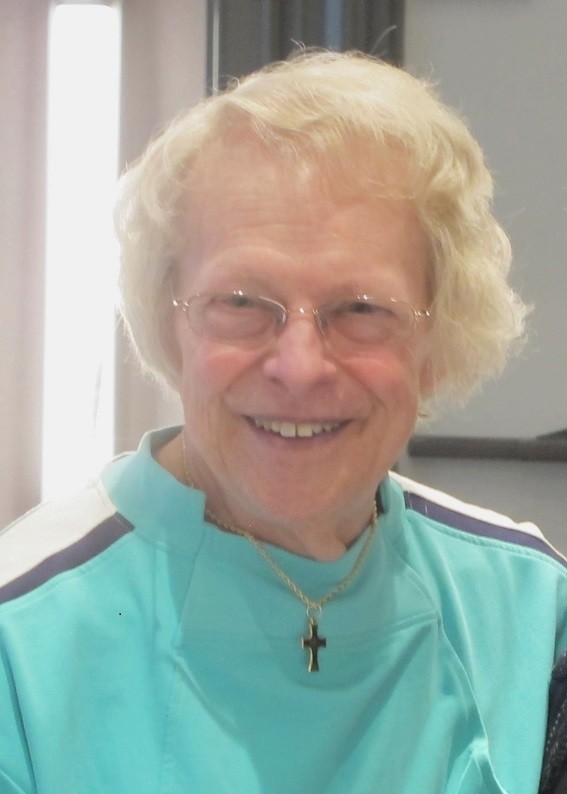
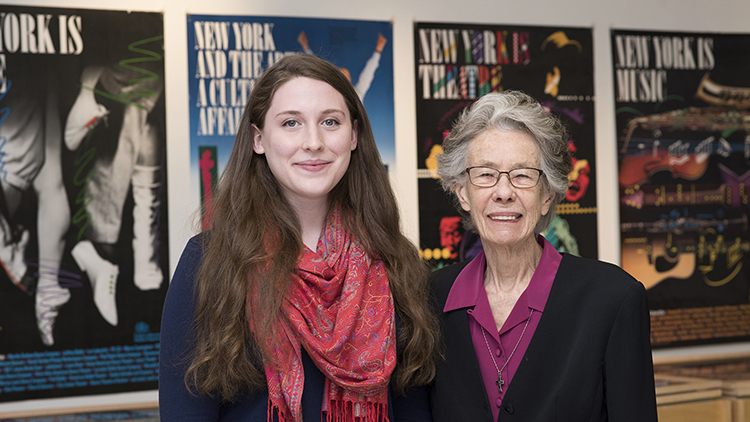
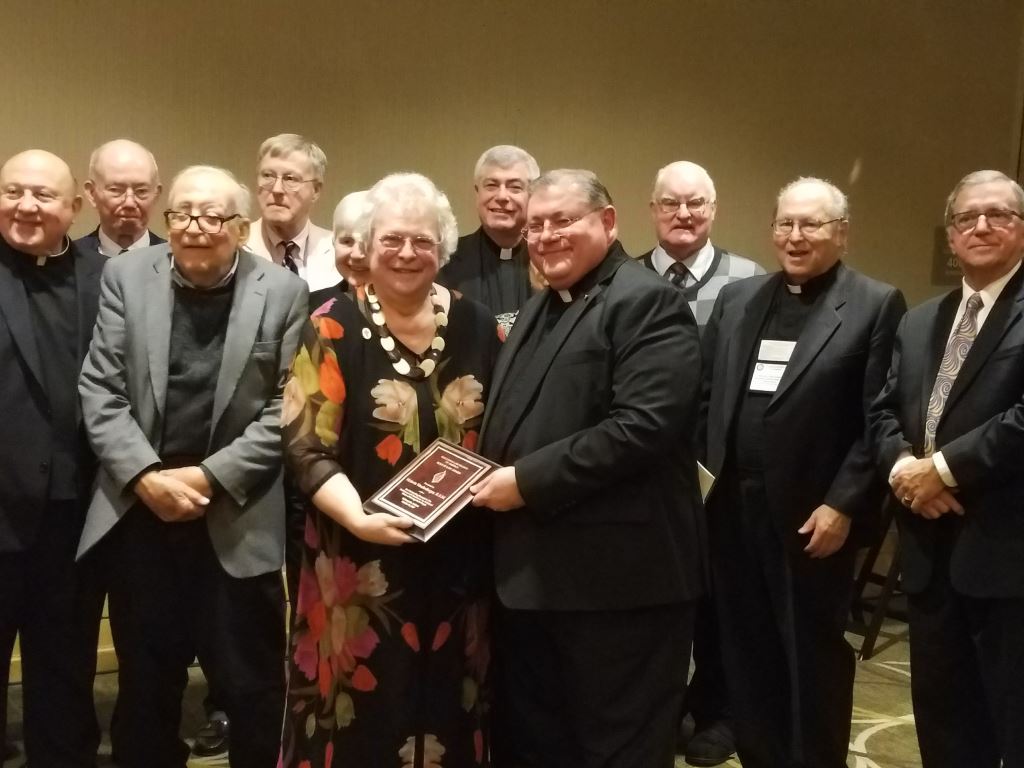
image: Victoria Vondenberger, RSM, receives the 2017 Role of Law Award
at the annual convention of the Canon Law Society of America